
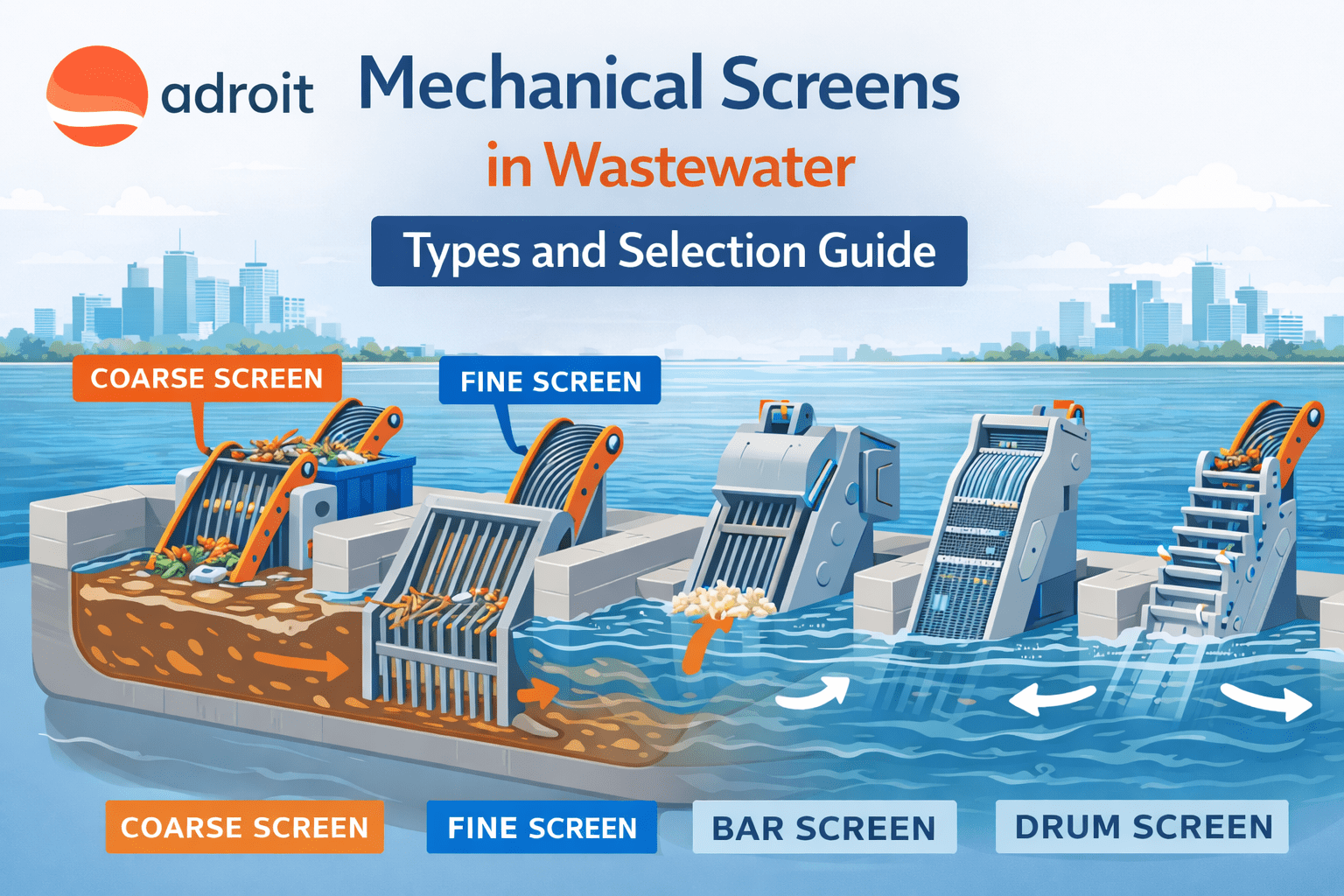

Mechanical screening process is the initial and important barrier in the operation of any wastewater treatment plant. Mechanical screens separate debris including rags, plastics, wipes, wood, grit and floating solids from incoming wastewater before any biological, chemical or tertiary treatment can occur.
Without effective screening:
- Clogged pumps and damaged impellers
- Fouled blowers or diffusers
- Loss of efficiency in biological reactors
- A considerable increase in maintenance costs
- Frequent plant downtime
Mechanical screens provide dependable preliminary treatment, stabilise the hydraulic flow of wastewater and safeguard the capital equipment in a wastewater treatment plant. At Adroit, we design our screening systems for maximum durability by utilizing corrosion resistant materials and designing our screening systems to be automation ready to support long term sustainability and to help meet the goals of efficient water reuse.
What Are Mechanical Screens in Wastewater Treatment?
Automated mechanical screens are first stage pretreatment devices that will remove large floating solids (plastic, rags, sticks) from the incoming wastewater at a wastewater treatment plant. Mechanical screens will generally use a motorised rake system or conveyor system to remove debris and protect equipment downstream from clogging, create better operating conditions, and reduce the need for manual cleaning.
Key features of mechanical screens include:
- Purpose: Protect pumps and treatment systems from clogging.
- Types: Chain driven, catenary, reciprocating rake, climbing, continuous belt.
- Benefit: Continuous and automatic function reduces labour and maintenance requirements.
Where Mechanical Screens Are Used in Treatment Train
Mechanical screens are typically found:
- At the inlet chamber
- Before grit chambers
- Upstream of primary clarifiers
Where Mechanical Screens Can Be Used
- Municipal WWTP’s
- Industrial ETP’s
- Combined sewer systems
- Pumping stations
Types of Mechanical Screens Used in Wastewater Treatment
The following types of mechanical screens are based on opening sizes, the way the mechanical screen is cleaned, installation angle and what the screen is being utilised for. The selection of mechanical screens for your application depends on the flow rate of the influent wastewater, solids loading, depth of the channel and type of downstream treatment.
1. Bar Screens
Bar Screens are the most commonly utilised style of screening in the municipal sewage treatment facility.
- Consists of vertical or inclined parallel steel
- Typical spacing between bars ranges from 15 to 50 mm
- Utilised for removing large debris, i.e. plastics, rags, sticks and bottles
- located at inlet works before grit chambers
- Available in manual or mechanically cleaned versions
Best suited for: Used as primary coarse screening equipment in municipal sewage treatment facilities.
2. Multirake Bar Screens
Multirake Bar Screens come from the standard Bar Screen and have also evolved into a higher capacity and more efficient mechanical screen.
- contain several rakes that operate at the same time
- remove materials constantly from the screen
- Ideal for high flow and deep channel applications
- reduce the risk of clogging and matting up of debris
Best suited for: Large municipal wastewater plants handling variable flow rates.
3. Step Screens
Step Screens are a type of mechanical screen that has been developed specifically for removing smaller solid waste.
- Stepped plate configuration
- Typical opening size between 2mm and 6mm
- self-cleaning mechanism by pulling the steps upwards
- Low head loss due to open flow design
- Compact footprint
Best suited for: Fine screening mechanical screen used before biological treatment units.
4. Rotary Drum Screens
Rotary drum screens consist of a perforated cylindrical drum that rotates to separate solids.
- Fine screening capability (1mm to 6mm openings)
- Internal spray cleaning system
- Suitable for compact installations
- Handles moderate to high solids load
Best suited for: Industrial effluent treatment plants and compact WWTPs.
5. Band Screens
Band Screens are a type of screening device that employs a constant belt or chain system to accomplish continuous or intermittent screening.
- continuous removal of debris from the screening area
- Suitable for wide and deep channels
- can handle the tracking of large volumes
- designed for both coarse and fine screening applications
Best suited for: large municipal facilities that create a lot of hydraulic hydraulic loads.
6. Grab Screens
Grab Screens are heavy-duty mechanical screens that are used for the removal of coarse debris materials.
- Operate using a mechanical grab bucket
- Used in deep channel applications and pumping stations
- require an intermittent cleaning operation
- effective for the removal of large and bulky solids
Best suited for: lift stations for raw sewage and high debris applications.
7. J-Type Screens
J-Type Screens have a curved screening surface and a relatively small footprint.
- allow for efficient solid capture
- Moderate screening capacity
- efficient use of space
- Used in small to medium plants
Best suited for: Decentralised treatment systems.
8. Basket Screens
Basket Screens are straightforward mechanical devices that have a removable basket in which debris accumulates.
- typically used for smaller flow rate applications
- easy to maintain and clean
- Lower automation level
- Cost effective solution
Best suited for: Small industrial units and pre treatment stages.
How Mechanical Screens Work
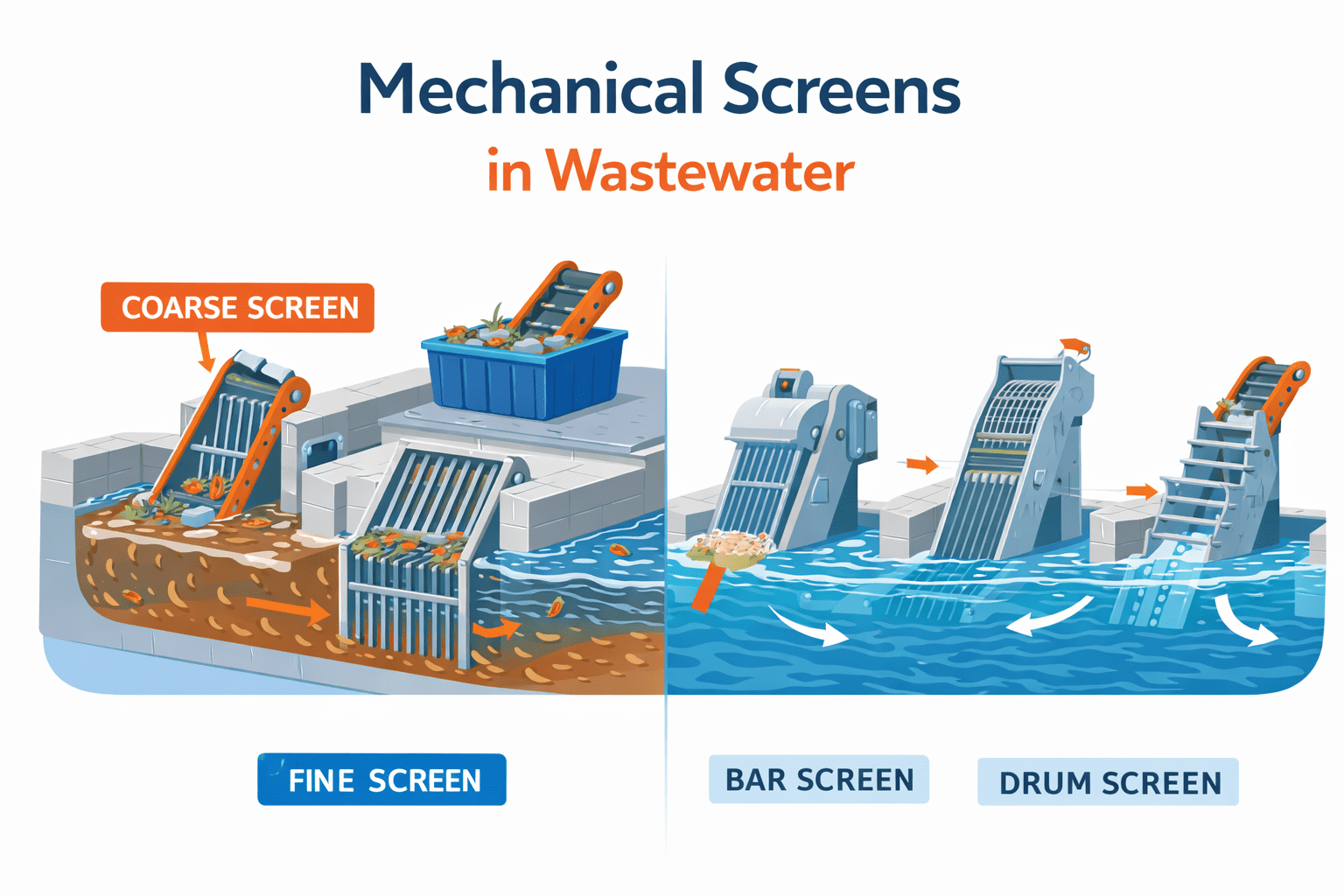
Mechanical screens serve to separate solids from incoming wastewater by permitting water to pass through predetermined openings, while retaining any solid material on the surface of the screen.
- As wastewater travels toward vertical and horizontally inclined screen panels or bars, larger solids are captured and smaller particles are filtered out through the available openings.
- As solids collect on the screen surfaces, the water level upstream of the screen will rise, thus creating a differential head.
- It is this differential head that activates either level sensors or time switches to the mechanical cleaning system via rake, rotating drum or step systems that will lift and discharge solids that have been collected.
- Solids collected on the screens will either be transferred to compactors or conveyors for disposal.
Key Design Criteria in Selecting Mechanical Screens
Selecting the correct type of mechanical screen requires the collection of engineering input.
- Flow Rates (Average & Peak)
High Avg Flow and Peak flow provide screening width and channel sizing criteria and provide for the surge of stormwater.
- Size of Screen Openings
- Coarse size: 15mm to 50mm screen openings
- Mid coarse size: 6mm to 15mm screen openings
- Fine size: 1mm to 6mm screen openings
The size of the screen openings depends on the treatment requirements of the downstream location.
- Wastewater Characteristics
- Municipal wastewater has a high level of rag content.
- Industrial wastewater has a high level of suspended solids, fibrous waste and chemicals.
- Head Loss Issues
- Too much head loss will result in an increased chance of flooding upstream.
- Head loss for mechanical screens is influenced by the bar spacing and the amount of debris collected on the bars.
- Installation Configuration
- In-channel installations only
- Vertically or inclined installations only
- Depth constraints in the channel
- Maintenance/Accessibility
- Acceptable system access
- Easy removal of wear items
- Material of Construction
- SS304 – normal municipal application materials
- SS316 – saline/corrosive industrial applications
Key Differences: Mechanical Screens vs Manual Screens
Here are some of the key differences between Mechanical Screens and Manual Screens:
| Parameter | Mechanical Screens | Manual Screens |
| Cleaning Method | Automated raking or rotating mechanism | Manually cleaned using hand rakes |
| Labor Requirement | Minimal manpower required | High labor dependency |
| Operational Efficiency | Continuous and consistent performance | Performance depends on operator availability |
| Safety | Reduced human contact with wastewater | Higher risk of injury and exposure |
| Head Loss Control | Automatic cleaning prevents excessive head loss | Delayed cleaning may increase head loss |
| Handling of High Flow | Suitable for peak and storm flows | Limited handling capacity |
| Maintenance | Scheduled preventive maintenance | Frequent manual intervention |
| Long Term Cost | Lower lifecycle cost despite higher initial investment | Lower upfront cost but higher operational expense |
| Reliability | High operational reliability | Prone to inconsistent cleaning |
Applications Across Industries
There are several applications of Mechanical Screens across different industries, which include:
- Municipal sewage treatment
- Food & beverage processing
- Textile dyeing and finishing plants
- Pharmaceutical effluent treatment
- Industrial manufacturing units
Why Choosing an Appropriate Mechanical Screen is Important
Choosing the right mechanical screening system can improve overall efficiency at a facility while minimising the risk associated with operations.
- Impressive performance – improving biological treatment systems
- Extensive lifespan – reducing the cost associated with pumps and other equipment maintenance
- Reduction in energy usage – allowing for greater production volumes without increasing overall energy usage
- Reliability – ensuring that the plant functions at maximum efficiency
- Compliance – Compliance with the regulations in place to protect aquatic life
How Adroit Engineers Advanced Mechanical Screening Solutions
Adroit provides long-term value by designing new screening systems with high-quality fabrication methods as well as high performance, low energy consuming drive mechanisms, and creating solutions through hydraulic calculations.
- Heavy duty stainless steel fabrication
- Energy efficient drive systems
- Corrosion resistant construction
- SCADA ready automation integration
- Support for municipal and industrial clients
Frequently Asked Questions About Mechanical Screens in Wastewater
Question. How can one calculate the necessary screen capacity during peak flow periods?
Answer. Design of a screen walking-type depending on the maximum hydraulic capacity which includes consideration of peak discharge due to storm events. Engineers will consider channel velocity and available area through the screen to determine the maximum allowable discharge head loss.
Question. What are the differences between coarse, medium and fine screens?
Answer. Coarse screens are used to filter out larger objects (>15 mm), medium screens are used to filter out moderate size solids (6 to 15 mm), and fine screens filter out the smallest solids (from 1 to 6 mm). Although fine screens improve the efficiency of downstream treatment, they also contribute to increased capital costs.
Question. How much head loss will be allowed to occur across a mechanical screen?
Answer. The allowable head loss will vary with distinct hydraulic characteristics of the plant, but it is maintained within safe parameters so that flooding does not occur at the upstream end of the mechanical screen. Proper screen diameter and use of automatic cleaning devices will help maintain stable head loss.
Question. Is it appropriate to use a mechanical screen for the treatment of high TSS industrial effluent?
Answer. Yes, provided the screen is built of corrosion resistant materials and designed properly. The physical requirements (fine screen and heavy-duty construction) of many industrial applications will further dictate the screening process design.
Question. What factors will affect the lifecycle cost of a mechanical screen?
Answer. The lifecycle cost of a mechanical screen will depend on material quality, corrosion resistance, energy usage, maintenance cycles and reliability under peak flow rate conditions.