
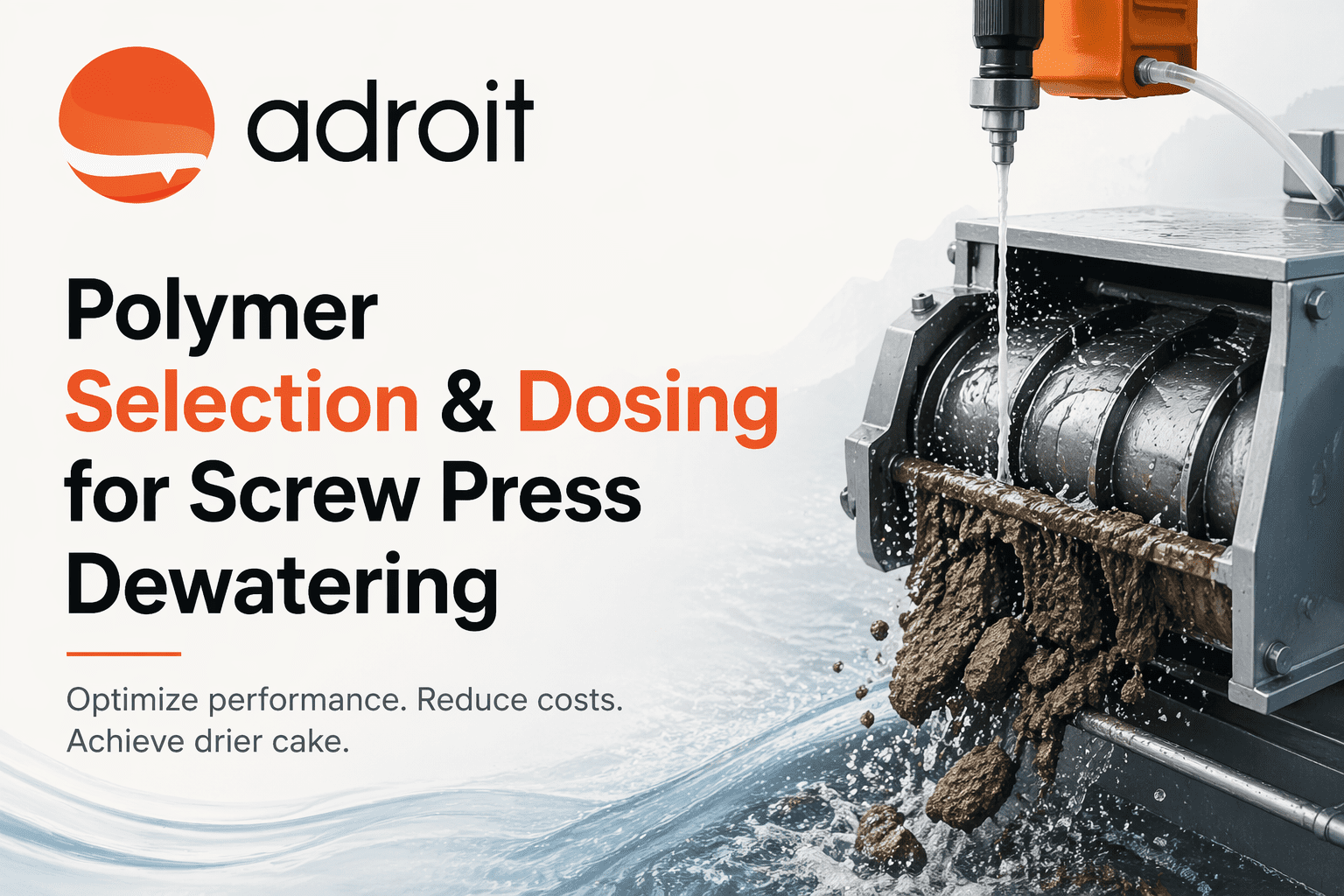

Dewatering sludge effectively is an extremely important, and often expensive, component of wastewater treatment facilities. Literature shows that dewatering and disposal account for 60% to 80% of total sludge management costs. Therefore, it is critical to optimize all facets of that process, but especially the selection and dosing of polymers.
Screw press dewatering systems have become increasingly popular due to their ability to use less energy and have lower maintenance costs. However, their success greatly depends on the use of polymers being correct. Selecting the proper polymer and dosing it correctly will result in a reduction of 30% to 50% of the total volume of sludge, thus greatly reducing the cost of transporting and disposing of it.
At Adroit, we provide innovative and efficient water and wastewater treatment solutions for municipalities and industry, and support clients in achieving optimum performance through the use of advanced engineering and process optimization.
What is Screw Press Dewatering Technology?
A screw press is a mechanical dewatering device that utilizes a rotating screw within a cylindrical screen to expel solids from liquids. Water is expelled from sludge as it is transported through the screw press, with the application of pressure increasing throughout (causing the water to be expelled, forming a dewatered sludge cake) throughout the process.
Screw presses have distinct advantages over traditional technologies such as:
- 30% to 50% less energy than a centrifuge or belt filter press
- Smaller footprint (less space required)
- More consistent and stable operation
- Lower noise and maintenance requirements
Screw presses can achieve 18% to 25% cake solids for municipal sludge which makes them one of the most efficient choices for many wastewater treatment plants.
Role of Polymers in Sludge Dewatering
Polymers (also known as flocculants) help to greatly improve the dewatering of sludge (removing water from it). They do this by aggregating (binding) fine solid particles into larger (floc) particles (flocculate), making them much easier to separate from water.
- Charge Neutralization
- Bridging Between Particles
Polymers will significantly improve solids capture rates (>95%); and reduce suspended solids in filtrate (water left after the solid is removed) by up to 80% if they are employed properly. Without a suitable polymer means that sludge will remain too fine to dewater efficiently.
Types of Polymers Used in Screw Press Systems
Types of Polymers Used With Screw Press
To provide the greatest success in using polymers, the correct type of polymer must be selected.
Cationic (`+`) Polymers
The most frequently used polymer in wastewater applications for biological sludge. They carry a positive charge which will function to neutralize the negatively charged sludge particles. In fact, about 70% of all dewatering applications across the globe utilize cationic polymers.
Anionic (`-`) Polymers
Generally used for inorganic sludge-type materials such as those encountered in industrial wastewater. They carry a negative charge and are effective when handling positively charged particles.
Non-Ionic Polymeric Material
Used with limited charge interaction situations (i.e. special) and are not as common but do find use in some industrial processing areas.
What are the Key Factors Influencing Polymer Selection?
Several major factors contribute when selecting a polymer for sludge.
Sludge Characteristics:
The type of sludge (organic or inorganic) will directly affect how a polymer behaves. Particle size, concentration of solids, and amount of oil or grease will play important roles as well.
pH and Temperature:
The efficiency of a particular type of polymer will have dramatic fluctuations depending on the pH or temperature at which the polymer is being used. Higher or lower extremes may need a unique blend of polymers to achieve desired results.
Screw Press Design:
Different designs of screw presses may use different physical polymer properties to achieve optimal results.
Regulatory Requirements:
In most places, there are environmental regulations that dictate the manner in which sludge can be disposed of, and consequently, the types of polymers that can be used.
Selecting the wrong polymer can lead to 20% to 40% higher chemical costs, while selecting the best polymer can improve the efficiency of dewatering by 25%.
Polymer Dosing: Why Precision is Critical
Even though the right polymer may have been used, if they are not dosed correctly, the results of the dewatering process will be compromised.
- Too little polymer will result in the formation of poor flocs and low solids capture.
- Too much polymer will result in excessively sticky material, increased costs, and operational inefficiencies.
- Overdosing alone can result in an increase in operational costs of 15 per cent to 30 per cent, while proper dosing can result in 20 per cent reductions in costs associated with sludge disposal.
- Achieving the correct balance will be essential to maintaining efficiency and cost effectiveness.
Methods for Determining Optimal Polymer Dose
Jar Testing
Jar testing is a frequently used laboratory method for determining the best type and dosage of polymer for a given application. It offers an expedited form of testing for determining the expected performance associated with using a particular polymer.
On-Site Pilot Testing
On-site pilot testing provides the opportunity for operators to observe and monitor real performance of polymers under actual plant conditions, resulting in more accurate test results.
Automated Dosing Systems
Modern automated dosing systems utilize sensors and control algorithms to simultaneously calibrate the almost instantaneously the dosing of polymers. Very sophisticated version of these systems can accomplish the following:
- Reduce the overall amount of polymers used by approximately 10-25%
- Increase the efficiency and consistency of the performance of treated sludge cake solids by as much as 15%.
Common Challenges in Polymer Dosing & How to Overcome Them
Variability of Sludge Quality – Variability in the characteristics and types of incoming waste can have a negative impact on the effective performance of polymers used in the production of sludge. Continuous and real time monitoring of sludge characteristics is critical to maintaining constant and effective polymer dosing.
Seasonal Temperature Changes – Seasonal temperature variation can affect the rate of reactions (flocculation) and ultimately have an impact on the ability to successfully create and use sludge.
Improper Mixing of Polymers & Sludge – If proper mixing of polymer and sludge does not occur, then the polymer may not effectively activate.
Equipment longevity – Over time, physical wear and tear can result in the loss of mechanical efficiency of the dosing system.
Solutions include:
- Implementing real-time monitoring systems
- Incorporating state-of-the-art dosing equipment
- Engaging consultation from industry experts
Best Practices for Polymer Preparation & Application
When preparing and using polymers, the following items should be considered:
- Dilution – Ensure polymers are fully diluted to their proper and required concentration.
- Aging – Adequate time for polymer activation.
- Mixing – Use controlled methods to accomplish the desired result.
- Injection – Use the proper injection point to ensure the best contact between the polymer and sludge.
Cost Optimization & ROI of Proper Polymer Use
There is significant expense related to polymer use (20% to 60% of the total cost; therefore by configuring to optimize the polymer use, there are three benefits achievable:
- reduced sludge volume
- reduced cost of the disposal of dewatered sludge
- improved efficiency of equipment
return on investment (roi) for the facilities to represented optimizing polymer use and dosing strategies is realized within 6 months to 12 months after implementation.
How Adroit Enhances Polymer Selection & Dosing
Adroits engineering excellence through innovation supports the need for efficient, reliable and sustainable waste water treatment. Adroit focuses on the following factors to provide solutions:
- custom designed and integrated screw press
- thorough sludge analysis to enable proper polymer selection
- advanced dosing systems to optimize dosing in real time
- compliance with iso:9001-2015 quality standards
- continuous improvement due to client feedback
Adroit and its staff are determined to provide solutions that are efficient, reliable, sustainable and benefit the customer.
Conclusion
To sum up everything that has been stated so far, the above given information on the topic “Polymer Selection & Dosing for Screw Press Dewatering” states everything you need to know about Polymer for Screw Press Dewatering, its role, types, key factors Influencing felection and more. If you want to learn more feel free to contact Adroit by dialing 0800 775 548 or dropping your quarries at [email protected].
FAQs About Polymer Selection & Dosing for Screw Press Dewatering
Question: What is a good type of polymer to use for municipal sludge?
Answer: Municipal wastewater sludge is best treated with cationic polymers because of their ability to neutralize the negative charge of the sludge particles.
Question: What are some signs that you may be under-dosing the polymer in a screw press?
Answer: Signs of under-dosing in a screw press include poor floc formation, low cake solids, high suspended solids in the filtrate, and poor separation of the sludge.
Question: What is the typical polymer dosage for a screw press system?
Answer: There is no standard dosage due to the various characteristic properties of sludge and the design of each system. Dosage is usually determined through testing for maximum solids capture with minimum usage of chemicals.
Question: How do I know what type of polymer to use for dewatering of screw presses?
Answer: The choice of polymer will depend on the type of sludge (organic/inorganic), charge character, pH, and solid concentration. The most effective polymer is usually determined by jar testing or pilot testing.