

Sludge management represents one of the highest costs as well as one of the most important aspects of wastewater treatment; it is estimated that the costs associated with Sludge handling and disposal comprise 30 – 50% of the total cost of plant operations. Therefore, this is an area that can be optimized. Increased Efficiency through the dewatering process will also lead to improved overall operating efficiency of the plant through reduced disposal costs.
Screw presses are becoming one of the more popular dewatering technologies because they use a small amount of energy, have a small footprint, and have the ability to operate continuously. Screw presses have been shown to use up to 60% less energy than other common dewatering equipment, such as centrifuges, making them a preferred method of dewatering in many industries.
The performance of a Screw press is not only affected by the design and size or other mechanical aspects; however, one of the most important contributing factors in achieving high efficiency from the performance of the machine is optimising the characteristics of the sludge being processed. By understanding the characteristics and optimising the characteristics, it will become possible to produce drier cake, reduce the amount of polymer used, and reduce the overall operating costs associated with using the screw press. Many companies, such as Adroit Water Technologies, help to optimise the sludge characteristics for industries so they can maximise the performance of their screw press.
What is a Screw Press and How Does it Work
A screw press separates water from sludge using a mechanical dewatering (separating liquids from solids) device (the screw) in order to accomplish this, the screw rotates or turns within a cylindrical screen. As the sludge passes through the press, the pressure will increase with the movement of the sludge, resulting in water being pressed out of the sludge or cake while the solids remain in the sludge cake.
Benefits of a screw press
- Low power consumption
- Continuous, automatic operation
- Very little noise and vibration
- Suitable for many different sludge types
Although a screw press offers many benefits, these benefits can be greatly dependent on how readily the sludge is able to be dewatered.
Importance of Sludge Characteristics
Sludge can be a very complicated mixture of water, organic matter, microorganisms, and inorganic solids. There are a number of factors that can determine what makes up the characteristics of sludge, including the source, municipal waste, food processing, and bio-pharmaceuticals/chemical manufacturing.
Effects of Sludge Characteristics
- How readily water can be removed from the sludge.
- How much polymer is needed to assist with the dewatering?
- The amount of dryness and cake volume of the final product.
- The stability of operation of the equipment.
If the sludge characteristics are not optimized, then no matter how advanced the screw press technology is, it will struggle to provide an efficient result.
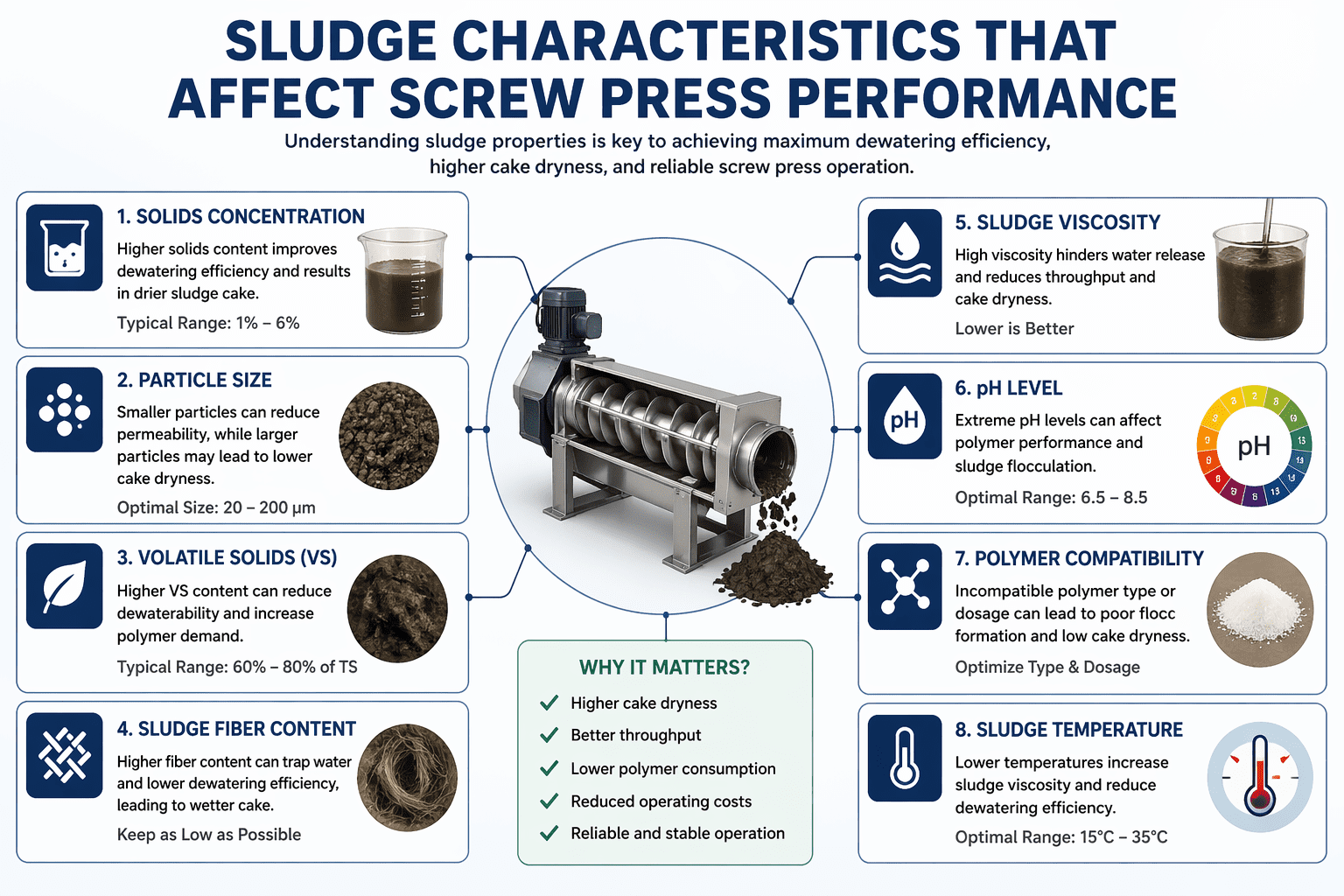
Four Key Sludge Characteristics Involved With Screw Press Performance:
- Solids Concentration (Total Solids %) – The Total Solids concentration coming into the screw press is probably the most important measurement out of all the Sludge Characteristics.
- An Ideal TS concentration for Sludge will range from 1 to 3%.
- Sludge that has a low concentration of TS will not Floc well and will create a low dryness cake.
- Sludge that has too high of a concentration of TS will create an increase in the load to the screw press and possibly cause a clogging condition in the screw press.
Observing these guidelines regarding the TS concentration or solids coming to the screw press will help ensure the smooth operation and optimum dewatering performance of the screw press.
- Particle Size Distribution – The size of the sludge particle is a critical aspect in Filtration as well.
- Larger sludge particles create good drainage pathways on the filter surfaces.
- Smaller sludge particles block the filter pores and ultimately reduce the efficiency of the filter.
Typically, sludge with a higher percentage of Large sludge particles will experience better dewatering performance.
- Organic Vs Inorganic Content – Due to the biological nature the Organic Sludge is going to hold more moisture than Inorganic sludge when it is dewatered.
- The greater the Organic content the lower the dryness achievable when dewatering the sludge.
- The Inorganic sludge is going to dewater more easily than Organic sludge.
Balancing the composition of the sludge is a significant consideration for improving to screw press dewatering performance.
- Sludge Age and Biological Activity – The Age of the sludge will have a large effect on its structure as well as settling characteristics.
- Younger sludge will not Floc well.
- Older sludge will have more desirable dewatering characteristics.
Maintaining proper process controls will assist in managing optimum sludge age.
- Polymer Conditioning
To assist with the formation of flocs, many industries use polymers to facilitate the removal of water. Selecting the right polymer, in the proper amount, is critical for optimal results. Too much polymer can unnecessarily increase cost while providing no special benefit. Too little polymer will not create adequate flocs.
Using the correct polymer type and dosage will increase the processing efficiency.
- Viscosity and Rheology
The viscosity of sludge is an important factor in determining how easily the sludge can flow and release water.
- High viscosity sludge presents a problem during dewatering methods.
- Low viscosity sludge will have improved flow and separation.
Understanding how the sludge behaves rheologically can assist industries with optimizing processes.
- Fiber and Oil Content
The presence of fibrous materials will help improve the sludge structure and provide better drainage.
Too much oil and grease will prevent the separation of the water from the sludge.
Industries that generate sludge with a high amount of oil may need to pre-treat the sludge to achieve acceptable results.
Effects of Poor Sludge Properties
If sludge is not produced with ideal characteristics, it can lead to the following operational issues:
- Less dry cake produced
- Increased use of polymer
- Frequent clogging and maintenance of equipment
- Higher disposal costs due to increased moisture
- Reduced the efficiency and service life of the equipment
These operational issues demonstrate how important good sludge management is.
Optimization Strategies to Improve Performance
Industries can achieve greater screw press efficiency by taking the following steps:
- Maintain the correct level of feed solids concentration
- Use the correct type and dosage of polymer
- Regularly monitor the sludge properties
- Pre-treat as needed
- Perform regular maintenance on the equipment
If the above recommendations are implemented, significant improvement in performance can be realized.
How Adroit Water Technologies Improves Screw Press Performance
We specialize in helping companies to optimize sludge dewatering processes.
Service Capabilities:
- Perform detailed analyses of sludge and measure systems’ performance
- Select the right polymer and optimize dosing
- Design and/or upgrade screw press systems
- Provide process automation and monitoring
- Provide custom solutions for many industries
With our knowledge, you will be able to achieve higher efficiencies, significantly reduce operating costs, and increase reliability.
Future Trends In Sludge Dewatering
- AI-based/sludge analysis
- Smart polymer dosing systems
- Energy-efficient technologies for dewatering
- Integration with digital monitoring solutions
The above trends will continue to enhance performance while being eco-friendly.
Commonly Asked Questions About Sludge Characteristics:
Which sludge characteristics impact screw press performance the most?
The sludge solids concentration, particle size, organic content, viscosity, and the use of polymers for conditioning all affect how well water can be removed from a sludge sample and, therefore, influence how efficiently and how much it will cost to operate a screw press dewatering system.
Why is polymer conditioning important in sludge dewatering?
Polymer conditioning is necessary in sludge treatment because of the creation of larger flocs for the easier separation of water from solids. When polymers are chosen and dosed correctly, they also provide cake dryness, save energy, and improve the overall performance of screw presses.
What is the ideal sludge concentration for screw press operation?
The ideal sludge feed concentration for screw presses is typically in the range of 1-3% total solids. Keeping it in this range provides optimal liquid removal performance, helps prevent clogging and helps maximize the dryness of the cake that is created.
How can poor sludge characteristics affect operational costs?
Poor quality of sludge can increase the cost of operation. In addition to increasing the amount of polymer used, poorly conditioned sludge will also increase maintenance costs and decrease the efficiency of dewatering. All of these factors can lead to higher costs associated with disposal and a shorter life of the equipment.
Why choose Adroit Water Technologies for sludge optimization?
Adroit Water Technologies provides sludge optimization solutions with expert applications for specific sludge characteristics. Adroit uses industry-leading techniques, which improve dewatering efficiency, reduce operating costs, and deliver reliable performance for wastewater treatment.
Conclusion
Performing well with screw presses is highly dependent on the characteristics of the sludge being processed. Understanding and optimizing these elements will help industries greatly improve their dewatering efficiencies, reduce costs, and improve overall plant performance.
Hiring experts to work with you, like Adroit Water Technologies, will give you a scientific and data-driven approach to managing your sludge in order to provide an environmentally friendly, cost-effective solution for treating your wastewater.