

Selecting an appropriate wastewater treatment technology is important for any facility because it directly impacts the environmental sustainability, compliance, and operational efficiency. Due to the numerous treatment options available, from conventional biological systems to advanced chemical processes, it becomes crucial to understand the specific requirements of your facility. Here, we are going to discuss how to choose the right wastewater treatment technology for your treatment facility. Stay tuned to learn more details!
How to Choose the Right Wastewater Treatment Technology for Your Treatment Facility
Wastewater treatment has become more important as water scarcity increases and regulations on water discharge become stricter. In cities and industries, traditional methods such as the ASP (Activated Sludge Process) and SBR (Sequential Batch Reactor) are widely used. However, the need for energy-saving, compact, and reusable technologies is growing rapidly. Here, we are going to explore both traditional and new treatment methods such as PCDF (Pile Cloth Disk Filters).
Conventional Wastewater Treatment Technologies
1. Preliminary Treatment
It is the first barrier that prevents damage to downstream equipment that might be caused by large debris and solids. Some common methods include:
- Bar Screens (Manual): It is used to trap rags, plastics, and large solids.
- Grit Chambers: Used to remove sand, gravel, and other heavy particles that settle quickly.
- Oil and Grease Removal Units: Floatation tanks are used to separate oils that may disrupt biological processes.
2. Primary Treatment
Under this, physical procedures are used for the removal of suspended solid and organic matter.
- Sedimentation Tanks: These allow solids to settle at the bottom.
- Primary Clarifiers: Before biological treatment begins, primary clarifiers are used to reduce total suspended solids (TSS) and biochemical oxygen demand (BOD).
Key Biological Treatment Technologies
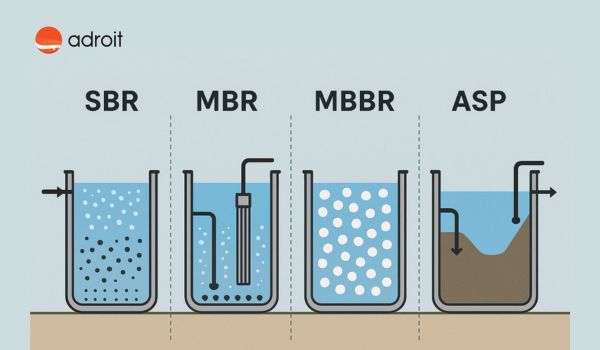
1. Activated Sludge Process (ASP)
ASP is a method where air is pumped into aeration tanks to support microbial digestion of organic pollutants. This method is most commonly used in large urban STPs (sewage treatment plants). This treatment technology offers high efficiency and can handle large volumes of wastewater.
2. Sequential Batch Reactor (SBR)
Sequential batch reactor is a treatment technology that works in a time-sequenced batch process with phases like fill, react, settle, and decant, and its flexibility and compact design make it suitable for conditions like variable flow. This compact technology is well-suited for small communities and industrial facilities.
3. Moving Bed Biofilm Reactor (MBBR)
MBBR provides high efficiency and a low footprint and uses bio-media carriers for enhancing microbial growth. It is suitable for upgrading existing plants or treating industrial wastewater with minimal maintenance.
4. Membrane Bioreactor (MBR)
MBR combines biological treatment with membrane filtration, producing clean effluent that is suitable for direct reuse. This method is suited for locations with strict discharge norms and small spaces. It is an ideal choice for space-limited areas with strict discharge standards because it is compact and highly effective at removing pathogens and solids.
5. Continuous Sequential Batch Reactor (CSBR)
CSBR is a hybrid solution that combines the continuous inflow capability with the batch advantages of SBR, offering high treatment capacity and faster cycle times. This treatment technology is suitable for high-load wastewater from urban areas or industries requiring scalable and efficient treatment solutions.
Tertiary and Advanced Treatment
Tertiary systems polish the effluent to meet discharge or reuse standards after biological treatment is completed:
1. Membrane-Based Filtration
Ultrafiltration (UF) – Removes suspended solids.
Nanofiltration (NF) and Reverse Osmosis (RO) – remove dissolved salts, viruses, and other contaminants.
2. Disinfection
- UV Irradiation (chemical-free and effective against most pathogens)
- Ozonation (powerful oxidation process, useful in water reuse schemes)
3. Pile Cloth Disk Filters (PCDF)
PCDF is an advanced tertiary treatment used to trap fine solids with the help of rotating disks covered in a specialized pile cloth media.
Advantages:
- Low energy consumption
- Compact, modular design for easy scalability
- Continuous operation with minimal downtime
- High polishing capacity
Applications:
- Industrial polishing units
- Replacement of aging sand filters
- Tertiary polishing in STPs for reuse in gardening, cooling, or irrigation
At Adroit, we offer custom-designed PCDTs that are built to support sustainable water reuse across sectors and meet stringent effluent norms.
Emerging Wastewater Treatment Technologies
The innovations are arising to improve efficiency, recovery, and environmental performance as the water demand increases:
1. Anaerobic Membrane Bioreactors (AnMBR)
AnMBR combines membrane filtration with anaerobic digestion, which makes it suitable for high-strength industrial wastewater. It produces minimal sludge and generates biogas.
2. Electrocoagulation and Electrooxidation
This treatment technology is effective in removing dyes, heavy metals, and pollutants found in the pharma, textile, and chemical industries.
3. Algal-Bacterial Systems
This treatment offers potential for biofuel generation and leverages natural algae-bacteria synergy for nutrient removal.
4. Forward Osmosis (FO)
In this, osmotic gradients are used to recover water with reduced energy consumption. This technique is suitable for brine minimization and water reuse.
5. Constructed Wetlands
Constructed Wetlands are natural-based systems that treat wastewater by using plants and soil microbes, suitable for low-maintenance and decentralized applications.
6. AI and IoT in STPs
Smart sensors and cloud-based analytics are used in AI and IoT in STPs that allow real-time monitoring, energy optimization, and predictive maintenance in treatment plants.
7. Containerized Treatment Plants
In this treatment technology, pre-engineered plug-and-play systems use MBBR, SBR, or MBR technologies, making it ideal for remote areas and temporary installations.
Future Trends
The wastewater treatment future lies in resource recovery and smart monitoring solutions:
- Water-Energy-Nutrient Recovery: Innovative technologies are being developed to recover clean water and also recover fertilizers and energy from wastewater.
- Smart STPs: Technologies are equipped with AI and remote monitoring dashboards and controls.
- Zero Liquid Discharge (ZLD): Significantly growing in industrial sectors, mainly in water-stressed areas.
Conclusion
To sum up everything that has been stated so far, wastewater treatment has evolved and has now become a key component for sustainable development. Now, facilities can achieve higher performance with innovative filtration technologies and the integration of advanced biological systems like CSBRs and MBRs.
Contact Us Today!
Contact Adroit Associates for expert guidance and technology selection according to your specific faculty needs. Below are the contact details:
Phone No: +91 70248-48383
Email: [email protected]
Address: 75/76, Sector-A, Sainath Colony, Indore, Madhya Pradesh 452018
Frequently Asked Questions About Choosing the Right Wastewater Treatment Technology for Your Treatment Facility
Question 1. Why is choosing the right wastewater treatment technology important?
Answer. It is important because selecting the right technology ensures regulatory compliance, cost-efficiency, environmental sustainability, and optimal system performance.
Question 2. What factors should be considered when selecting a wastewater treatment technology?
Answer. Key factors that you should consider include:
- Type and volume of wastewater
- Contaminant load and removal targets
- Regulatory requirements
- Budget and operating costs
- Space availability
- Technical expertise and maintenance capability
Question 3. How much space is required for a wastewater treatment plant?
Answer. The space required for a wastewater treatment plant depends on the technology; compact systems like MBBR or MBR need less space compared to conventional activated sludge processes.
Question 4. What are the risks of choosing the wrong technology?
Answer. The risk of choosing the wrong technology includes:
- Non-compliance with environmental norms
- Higher operational costs
- Frequent breakdowns
- Overloading and system failure
- Odor and nuisance complaints