
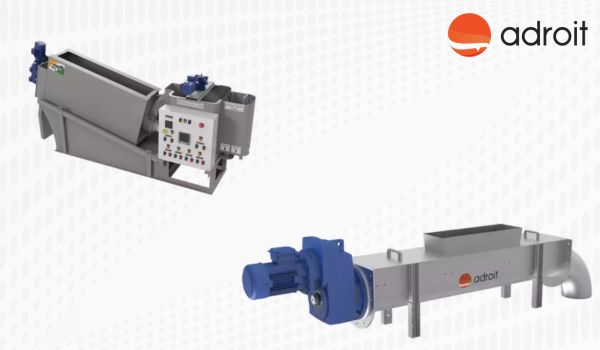

Sludge dewatering is a crucial part of wastewater treatment that decreases the quantity and weight of waste. It splits water from solid elements in the sludge, making disposal more straightforward and more eco-friendly. There are many methods for sludge dewatering, every method has its benefits and disadvantages. In this blog article, we will look at 4 popular methods like Screw Press, Filter Press, Belt Press, and Centrifuge. And, explore Sludge Dewatering: A Comparison of Screw Press, Filter Press, Belt Press, and Centrifuge.
Sludge Dewatering: A Comparison of Screw Press, Filter Press, Belt Press, and Centrifuge
How Sludge Dewatering Equipment Works: A Detailed Comparison
Here we will discuss how each of these methods operates, and address their key features, along with a detailed comparison of their performance, expenses, and functionality.
Screw Press
The screw press is a low-speed, energy-efficient equipment that constantly extracts water from sludge. It has a rotating screw rod inside a cylindrical mesh. As sludge moves along the screw, it gets compact, pushing water via the screen’s openings. Unlike other methods, it utilizes slow-speed mechanical compression and high torque rather than hydraulic pressure.
Key Features:
- Constant Working: It works constantly without stopping for the dewatering procedure.
- Low Noise and Vibration: This device works calmly, making it suitable for metropolitan areas.
- Minimal Wash Water Usage: It needs a small amount of water for washing, which is perfect for areas with restricted water supply.
- Close Footprint: It can be installed in tight spaces because of its compact structure.
The screw press is excellent device for applications requiring ongoing working. Its low energy consumption makes it an affordable and leading choice for cities and industries.
Filter Press
The filter press works in grouping mode, meaning it operates in cycles. Sludge is pumped into filter containers lined with filter cloth, and hydraulic pressure is used to move out the water, leaving a thick sludge behind. Once the cycle is finished, the plates are unclogged manually or automatically to remove the sludge.
Key Features:
- Produces High Dry Solids: The Filter press effectively performs high levels of dewatering, resulting in a dry sludge.
- Labor-Intensive: It needs manual or automatic functioning to extract the sludge after every cycle.
- Requires High-Pressure Pumps: In filter presses, high-pressure pumps are crucial to form the needed hydraulic pressure.
- High Energy and Wash Water Usage: It utilizes more energy and wash water than other devices.
Filter presses are perfect for those industries that require comprehensive dewatering, like mining and chemical manufacturing.
Belt Press
The belt press dewatering system utilizes 2 moving belts that compress out water. The sludge is first treated with chemicals to secure the elements and then put between the belts. As the belts pass via rollers, force is applied to move out the water. This procedure works constantly and is mainly utilized in municipal wastewater treatment.
Key Features:
- Constant working: The belt press delivers constant dewatering, equivalent to the screw press device.
- Moderate Dryness: It produces a relatively dry sludge, but not as dry as a filter press.
- High Wash Water Need: This system requires a huge amount of wash water to extract extra moisture.
- High Wear & Tear on Belts: The belts experience notable wear, which can lead to expanded maintenance expenses.
Belt presses are commonly utilized when ongoing processing is required, but achieving very high dryness is not a major problem.
Centrifuge
The centrifuge utilizes high-speed rotation to separate solids from liquids. Sludge is introduced into a spinning bowl, and the centrifugal power pushes more serious solid elements to the outside, while the liquid is released individually. This process functions well for sludges with a ton of water.
Key Features:
- High Throughput: Centrifuges can treat a huge quantity of sludge faster.
- High Energy Consumption: The fast rotation needs a lot of power, making it an energy-intensive choice.
- Difficult Maintenance: Frequent maintenance is required to keep the high-speed features working correctly.
- Noisy Operation: The spinning bowl forms a lot of noise while working.
Centrifuge Press is a significant choice for those applications that require fast working and dewatering. And, Its high energy consumption and difficult maintenance may not be perfect for smaller procedures.
Screw Press vs Other Technologies: Comparative Table
| Parameter | Screw Press | Filter Press | Belt Press | Centrifuge |
| Operation Mode | Continuous | Batch | Continuous | Continuous |
| Power Consumption | Low | Moderate | High | Very High |
| Dry Solids Output | Moderate–High | Very High | Moderate | High |
| Polyelectrolyte Use | Low | Moderate | High | High |
| Wash Water Requirement | Very Low | High | Very High | High |
| Maintenance Cost | Low | Moderate–High | High | Very High |
| Noise & Vibration | Very Low | Low | Moderate | Very High |
| Footprint | Compact | Large | Large | Medium |
| Ease of Operation | Very Simple | Complex | Moderate | Complex |
| O&M Cost | Very Low | High | High | Very High |
Why Screw Press is the Best?
The screw press stands out as the top choice for multiple applications because of many key benefits like:
- It works at low speed, which greatly lowers energy consumption and decreases operating expenses.
- Because of the minimum need for wash water, it is a significant choice for water-scarce spaces and saves money on wastewater treatment.
- It has fewer moving parts means less wear & tear, leading to lowered maintenance requirements and a more extended lifespan.
- Its compact structure allows for installation in tight areas, making it perfect for smaller treatment units.
- The screw press works calmly, making it perfect for noise-sensitive or residential areas.
- Its simple structure and automation elements lower the requirement for professional labor, decreasing operational costs and facilitating training.
Conclusion
In conclusion, sludge dewatering is a crucial step of wastewater treatment, and among the methods explored in this article, the screw press stands out as the most universal and efficient choice. Its energy efficiency, low water usage, low-maintenance, packed design, and silent working make it perfect for a wide range of applications. Even if in cities or treatment plants, the screw press delivers a dedicated solution for effective sludge dewatering.
FAQS for Sludge Dewatering: A Comparison of Screw Press, Filter Press, Belt Press, and Centrifuge
Question 1. How does the screw press work in dewatering?
Answer: A screw press utilizes a moving screw shaft within a cylindrical screen to closed sludge and release water. It works constantly and based on low-speed mechanical compression.
Question 2. Is the belt press perfect for municipal wastewater treatment projects?
Answer: Yes, the belt press is a perfect choice for municipal wastewater treatment projects as it provides constant working. While it produces relatively dry sludge and needs a huge amount of wash water.
Question 3. How do we decide which dewatering method is perfect for our project?
Answer: Your choice of dewatering method should be based on different aspects like the quantity and type of sludge, needed dryness levels, space, budget, and the working requirements of your unit.