
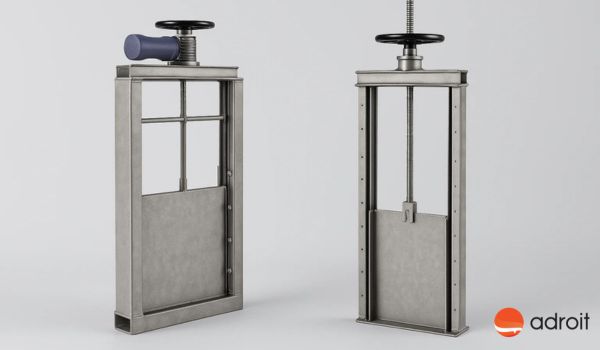

Hydraulic vs. Manual Sluice Gates: Performance and Cost Comparison – In a water control project like an irrigation canal, a dam, and a wastewater treatment plant, it is important to install sluice gates, which help to regulate the flow of water. When it comes to choosing between hydraulic and manual sluice gates, one question readily comes to mind: which of these two types will offer you the best performance, efficiency, and low cost in your particular application? So, let’s understand the difference between Hydraulic and Manual Sluice Gates based on performance and cost comparison.
What Are Sluice Gates and Why Are They Important?
Before we compare, we need to know what a sluice gate is. A sluice gate is a vertical gate that opens or closes in a way to regulate the flow of water. Consider it like a dam regulating the amount of water that can flow through. It is critical in the management of irrigation, flood control, the generation of power in hydroelectric dams, and the water levels in reservoirs.
The selection of your sluice gate will determine how well your system performs, how often it can be maintained, how safe it is, and how much it will cost, both initially and in the long term.
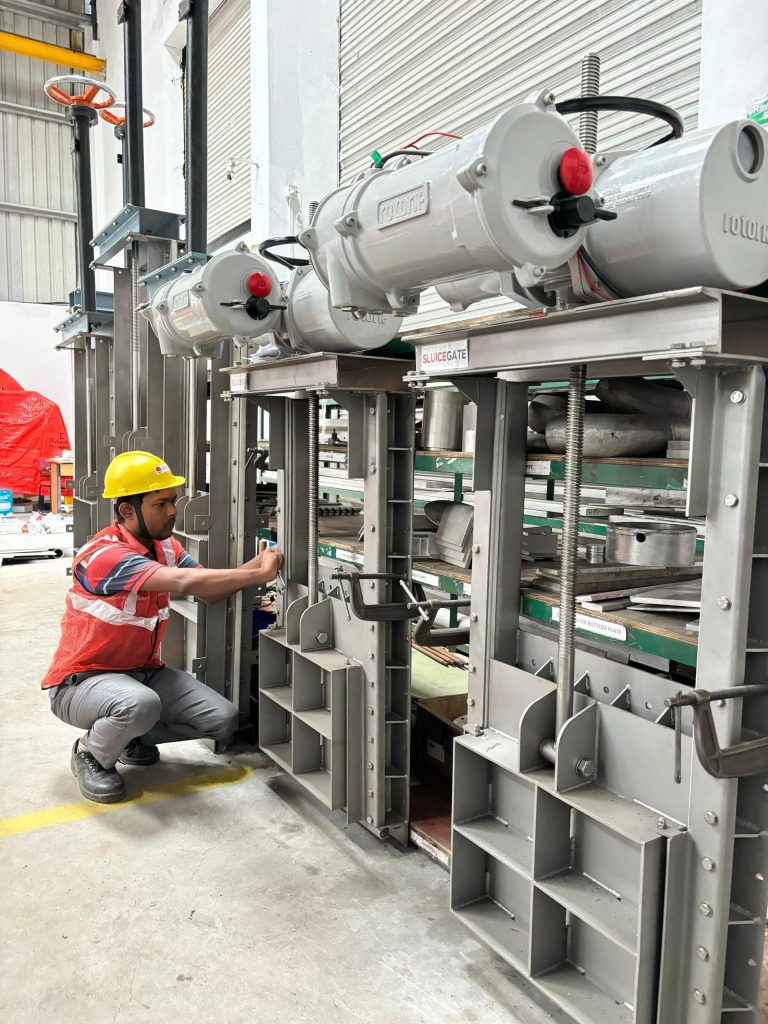
Key characteristics of Manual Sluice Gate
Manual sluice gates can be operated using a hand wheel, lever, or gears that enable an individual to raise and lower the gate. This is what makes manual gates a worthwhile choice:
- Low Cost of Initial Investment: The Cost of manual gates is normally low in the installation process. You do not require additional equipment, energy sources, or complicated control systems.
- Easy to use: If you only have low water pressure or low flow rates, or the gate does not require a lot of frequent readjustments, then manual operation can be useful.
- Low Maintenance: These gates are of lower maintenance as they have fewer moving parts and lack hydraulics.
- Suitable for Remote or Small Sites: In places where the power supply or technical support is minimized, manual gates can be a firm control.
Hydraulic Sluice Gates and their characteristics
Hydraulic sluice gates operate by hydraulic cylinders driven by a pump to open or close the gate by remote control or automatic operation. This is the reason why many modern infrastructures are inclined toward hydraulics:
- Simpler and Quicker Operation: Hydraulics ensure fast reaction, which is essential when dealing with flood control or fine mass flow control during an emergency.
- Automatic and Distance Control: Greater safety and less reliance on human labor is achieved due to operators being able to control gates at a distance with control panels.
- Bears Up Against High Water Pressure: Hydraulic systems exert the force to move heavy gates against high water pressure with ease.
- Smooth and Precise Adjustment: Hydraulic strokes allow smooth and precise control of the gate’s position to provide optimal control of flows, reducing either overflow or losses.
- Safety and Reliability: They are often supported by safety features and backups, and in the event of an emergency, the hydraulic gates can be closed automatically to prevent catastrophe.
Performance Comparison between Hydraulic and Manual Sluice Gates
Let’s try to understand which one of them is better in terms of performance:
- Speed: Hydraulic gates tend to be significantly faster than manual, particularly when fast opening and closing of gates is required.
- Hydraulic control precision: Hydraulics provide the accuracy to open gates in steps to suit the flow demands, as opposed to manual gates that are only as accurate as a person can get physically.
- Safety: Hydraulic systems minimize danger to workers as the systems allow remote handling and integration of automated safety features.
- Durability: Both types can be constructed to be durable, but the hydraulic gates are generally more resistant to corrosion and wear and will generally require more frequent maintenance.
- Operational Expenses: Manual gates can be cheaper in the long-term in terms of repairs, but more expensive with regard to labor requirements; hydraulics can be more expensive regarding labor but are more affordable in professional repair.
Cost Comparison: Know the core difference
Initial costs:
- Manual sluice gates: less initial expenditure. Well-suited to small-scale schemes, irrigation canals, or where there is a limited budget available.
- Hydraulic sluice gates: more expensive up-front costs because of hydraulic cylinders, pumps, and controls.
Operational costs:
- Manual sluice gates require labor more often, and this can add to the expenses.
- Hydraulic sluice gates are expensive in terms of hydraulic maintenance, but may be efficient in operation in that regard.
Long-term value:
- Manual gates are less complex and are not subject to as many technical failures, and may last many decades with only bare maintenance.
- Hydraulic gates are more efficient and automated, creating fewer risks and losses because of flooding or inefficient flow control.
Which one should you consider for your project?
The level of scale and complexity: High water pressure dams, treatment plans, or flood control sites are projects that lead to the application of hydraulics.
- Frequency and Speed of Operation: In operations where changes are frequent or emergencies exist, hydraulics are best.
- Limited Budget Availability: Manual gates are cost-effective for remote, low-budget projects.
- Maintenance Capacity: Hydraulics are labour-intensive and need technical maintenance, and the manual is safer.
- Safety Prioritization: Hydraulic systems can be used to increase safety by implementing remote automation.

Conclusion
Whether you choose a hydraulic or a manual sluice gate to use in your project is not only a matter of how much you can spare, but also a matter of how you operate, and the safety and maintenance requirements. If fast control and automation are needed, then the hydraulic system is optimal, and a manual gate, on the other hand, is highly adequate when simplicity and low cost need to be targeted. Be clear about what is needed for your site, and then come to a certain decision.
Frequently Asked Questions about Hydraulic and Manual Sluice Gates
Question 1. Are hydraulic sluice gates controlled automatically during emergencies, or always require human intervention?
Answer: The major benefit of hydraulic sluice gates is that they are automated. They have features to be operated at any moment in case of emergency, like sudden flood or overload, by remote control or pre-set automatic controls. By ensuring regular maintenance of the system and a fail-safe mechanism, you do not have to be physically present every time there is a small problem.
2. My project site is a remote location where power cuts are very frequent. Should I use a hydraulic gate or a manual one?
Answer: In remote locations and power cut situations, the manual sluice gates are more favourable since they do not need any electricity to operate. Although hydraulic gates are efficient, they should be coupled with a reliable source of power; otherwise, some backup systems will need to be put in place. If you can manage a power contingency, only then can you use the hydraulic gate; otherwise, manual is preferable.
Question 3. Are the maintenance expenses of hydraulic gates so high that manual gates have lower long-run costs?
Answer: The initial cost and periodic cost of hydraulic gates are certainly expensive compared to manual gates. Hydraulic gates can be cost-effective over a long period, but only when labour costs are high, high frequency of operation, or economy of time is essential. All is dependent on your operation requirements and the local conditions; calculations are different at every point.
Question 4. Is it possible to convert a manual sluice gate to a hydraulic system in the future, or do I need a new gate?
Answer: Manual sluice gates can generally be converted to hydraulic operation, subject to the design and construction of the gate. The lightweight or low-grade manual gates are simple to upgrade with hydraulic cylinders. The system as a whole might need to be replaced, however, in case the gate is not constructed well. Carry out a professional survey and have professional guidance before going ahead to upgrade.