

What happens if a single blockage could stop the entire STP? In sewage treatment plants (STPs), that risk is real, and it begins with screening. Screening is the most crucial step in the wastewater treatment process, which removes large solids, plastics, and debris. It helps to protect pumps, pipelines, and other equipment from clogging and damage. It is used to ensure smooth system operation in sewage treatment.
Sewage treatment plants need simple, reliable, and low-maintenance solutions because small-capacity plants often face challenges such as limited space, low budgets, and a lack of skilled workers. The J-type manual bar screens are compact, cost-effective, and easy to operate, which makes them the best choice for efficient screening in small-scale STPs. It ensures consistent performance and reduces the maintenance requirements of systems.
In this guide, you will learn everything about the J-type manual bar screen, how it works, its design criteria, and the selection guide for small STPs.
What is a J-Type Manual Bar Screen?
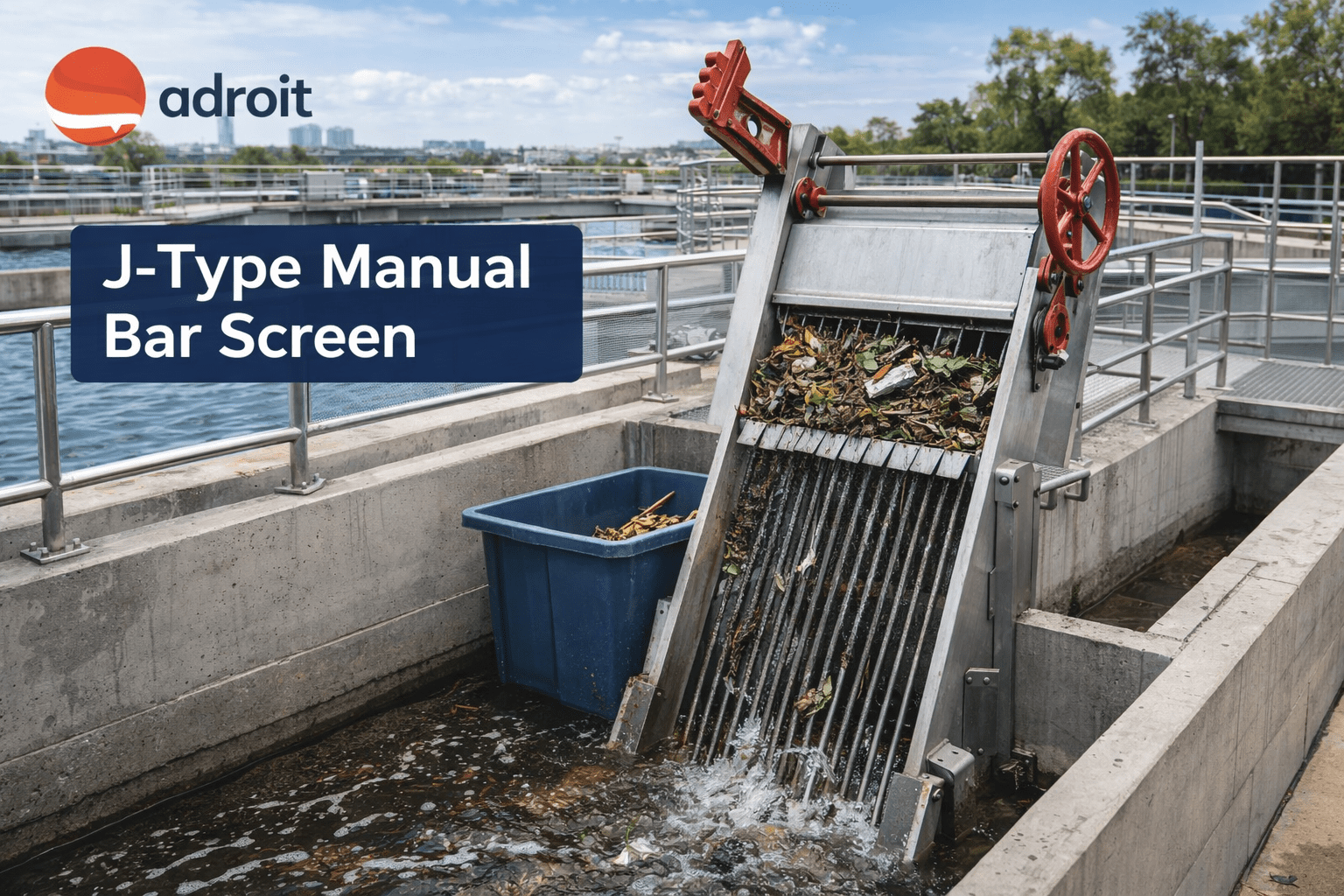
A J-type manual bar screen is a coarse screening device that is used in sewage treatment plants to remove large solids from wastewater using a set of inclined bars. Its structure consists of a screen frame to hold bars in position, an inclined bar rack (J-shape) to trap solid waste, a manual rake to remove collected screening, and collection areas to temporarily store for disposal. Wastewater flows through the inclined bars, where large solids are trapped on the screen surface and removed by the rack.
It is called a J-type screen because the bar rack is designed in a curved, J-shaped profile to facilitate the easy accumulation and lifting of debris. Straight bar screens are in a flat or vertical shape, which requires more space but gives moderate efficiency, and they are very difficult to clean. While J-type screens are in a curved shape, they require compact space, provide better efficiency, and are easy to clean.
Key Components of a J-Type Manual Bar Screen
- Curved bar screen frame:
It provides the structural shape to the screen and helps systems to collect debris easily.
- Stainless steel bars or flat plates:
Main filtering elements, which trap the large solids and allow water to flow through the screen.
- Screen support structure:
It is used to keep the screen stable and fixed within the channel.
- Manual raking mechanism:
Cleaning tools are used by an operator to remove collected waste from the screen surface.
- Debris collection arrangement:
Areas where the removed wastes are stored temporarily before disposal.
How does a J-Type Manual Bar Screen work?
The working of J-type manual bar screens is straightforward, and they do not require any automation system. Incoming sewage enters the channel, and wastewater flows through the inclined J-type bar screen. Large materials are trapped on the front side of the bar screen. Operators use a manual hand cleaning tool to remove collected debris from the curved screen. Removed wastes are stored in the designated bins for proper disposal, while cleaned water flows continuously for the next treatment stage.
Design Criteria for J-Type Manual Bar Screens
A well-designed system is very important in small sewage treatment plants to ensure smooth operations, effective screening, and low maintenance. These are the key factors required to design efficient J-type manual bar screens.
- Flow Rate and Channel Size:
These factors define how much wastewater the screen has to handle.
- The screen must handle average and peak flow.
- Channel dimensions must support hydraulic capacity, so water flows smoothly without overflow.
- Bar Spacing:
It controls the size of the solid removed.
- Bar spacing typically ranges between 10 and 50 mm.
- Smaller spacing improves system efficiency but requires efficient cleaning. Where large spacing reduces maintenance but decreases the efficiency rate.
- Screen Angle and Curvature:
The system screen is designed in an inclined and curved profile.
- An angled screen helps to flow wastewater smoothly and prevents clogging.
- The curves make it easier to collect and remove debris.
- Head Loss Considerations:
It is the reduction of the water level due to the screen.
- Design a system by maintaining hydraulic performance so it allows water to pass with minimal resistance.
- Design must prevent upstream flooding.
- Material Selection:
It affects the system’s durability and maintenance.
- Choose stainless steel SS304 or SS316 for better strength and long life.
- Material must be corrosion-resistant and durable to ensure reliable performance over time.
Applications of J-Type Manual Bar Screens
It is widely used in small-scale and low-maintenance wastewater treatment systems because of their simple design and reliability. Some common applications are:
Small Municipal STPs:
- Used in residential societies to remove daily household waste.
- Small community treatment plants are used in low-flow areas, which require simple operations.
Commercial Buildings:
- Used in hotels and resorts to handle food waste and debris.
- Used in hospitals and institutions to prevent the entry of solid waste into sensitive treatment systems.
Industrial Pre-Treatment:
- Used in small-scale manufacturing units to remove coarse solids.
- Used in food processing facilities to capture organic waste and packaging.
Pumping Stations:
- Used in pumping stations to protect pumps from debris.
- Used to ensure smooth pump operations.
Advantages of J-Type Manual Bar Screens
It offers various practical advantages for the wastewater treatment system.
- Simple and cost-effective design, which is easy to install and operate.
- Low installation and operational costs make them the best choice for low-budget projects.
- It has minimal power requirements, which makes it ideal for limited electricity supply areas.
- It is easy to maintain and perform manual operations.
Limitations of Manual Bar Screens
- It requires regular manual cleaning.
- It is not suitable for high-flow-rate systems.
- Its performance depends on operator efficiency.
Factors to Consider When Selecting a J-Type Manual Bar Screen
Some key factors to consider to select a J-type manual bar screen are plant capacity (KLD/MLD), which determines the hydraulic load the screen must handle, and the load of solids in wastewater, which may affect the spacing of bars and frequency of cleaning. The system screen must fit within the channel dimensions. Check maintenance capabilities available in areas and budget constraints to choose a cost-effective and efficient system.
When to Choose J-Type Screens?
- J-type screens are best suited for small flow STPs.
- Choose where manual operation is preferred, and there is no need for an automation system.
- Projects that have low installation and maintenance costs.
Installation and Maintenance Considerations
Proper installation and maintenance of systems is most important to get smooth and efficient performance. The screen must be aligned and installed within the channel. Perform regular cleaning of debris to avoid clogging and maintain efficiency. Inspect bar spacing and structural condition to maintain the consistency of operations. Use corrosion-resistant materials and perform routine checks to prevent corrosion and damage.
Why J-Type Screens Are Ideal for Decentralized STPs?
J-type screens are ideal for decentralized STPs because they offer compact and simple designs that can be easily set up in small spaces. They provide reliable coarse screening solutions at low energy requirements. Due to the compact and simple design, it makes easy integration in small wastewater plants. All these factors make it an efficient choice for decentralized STPs.
How Adroit Designs Reliable J-Type Bar Screens?
Adroit designs ensure high performance with J-type bar screens through custom fabrication requirements of projects, which allow a perfect fit and efficiency for each system. Their screens are built with corrosion-resistant stainless steel construction to ensure durability. They offer long life and consistent performance with less maintenance due to robust structural design. Adroit offers various solutions for municipal and industrial wastewater applications.
Frequently Asked Questions (FAQs)
Q1. What is the purpose of a J-Type manual bar screen in an STP?
Ans: The purpose of a J-type manual bar screen in an STP is to remove large solid waste from wastewater to protect equipment and improve treatment efficiency.
Q2. What is the typical bar spacing used in J-Type screens?
Ans: The bar spacing typically ranges between 10 and 50 mm, depending on the requirements of the application.
Q3. How often should manual bar screens be cleaned?
Ans: Cleaning of manual bar screens depends on the flow and solid load. But daily cleaning prevents clogging.
Q4. What material is best for J-Type bar screens?
Ans: Stainless steel SS304 or SS316 corrosion-resistant materials are best for J-type bar screens.
Q5. Are J-Type screens suitable for industrial wastewater?
Ans: Yes, it is suitable for small-scale industrial wastewater, especially for removing coarse solids.
Q6. What is the difference between manual and mechanical bar screens?
Ans: Manual bar screens require human hands to clean, but mechanical bar screens use an automated system to clean.
Q7. Can J-Type bar screens handle peak flow conditions?
Ans: Yes, if the system is properly designed, then it can handle both normal flow and peak flow conditions.