

An Aerated lagoon is an efficient and affordable solution for treating sewage and wastewater, effectively easing biochemical oxygen demand and total suspended solids while keeping procedures easy. Regardless, achieving optimal treatment performance needs accurate engineering, especially in mixing and aeration.
Submersible mixers and jet aspirators are important in improving the lagoon’s significance. In this blog, we will discuss the Aerated Lagoon for Sewage Treatment: Role of Submersible Mixers/Jet Aspirators.
Aerated Lagoon for Sewage Treatment: Role of Submersible Mixers and Jet Aspirators | Understanding the Basics of Aerated Lagoons
Aerated lagoons are external earthen basins utilized for natural wastewater treatment. Normally 2 to 5 meters deep, these lagoons treat municipal or industrial waste by raising oxygen into the water. It allows aerobic microorganisms to break down organic matter, such as BOD, converting it into carbon dioxide (CO₂), water, and microbial biomass.
Aerated lagoons function in two major zones:
- Aerobic Zone – Supply Oxygen actively, allowing for the degradation of BOD by aerobic microorganisms. The existence of oxygen is required for biological treatment.
- Settling Zone – Solid waste slowly settles before being removed from the lagoon. The settling spot helps ensure that solid waste does not interfere with the treatment procedure.
The Significance of Mixing and Aeration in Aerated Lagoons
The effective treatment of wastewater depends on aeration and proper mixing in aerated lagoons. The supply of oxygen allows aerobic microorganisms to break down organic contaminants. And, Mixing ensures that solid garbage remains suspended in the water, controlling earlier settling. Solid waste could settle at the bottom without sufficient mixing, leading to anaerobic zones where oxygen is inaccessible.
Insufficient mixing and Aeration cause major problems like:
- Earlier Solids Deposition: It leads solids to low oxygen areas and reduces the entire efficacy of the treatment procedure.
- Anaerobic Zones: Anaerobic zones are made where microorganisms cannot survive without proper mixing. It causes an increase in the production of undesirable gases like methane and hydrogen sulfide.
- Odor Problems: Insufficient Mixing forms stagnation, which can lead to the appearance of bad smells. It is a common problem in untreated wastewater.
The Role of Submersible Mixers in Aerated Lagoons
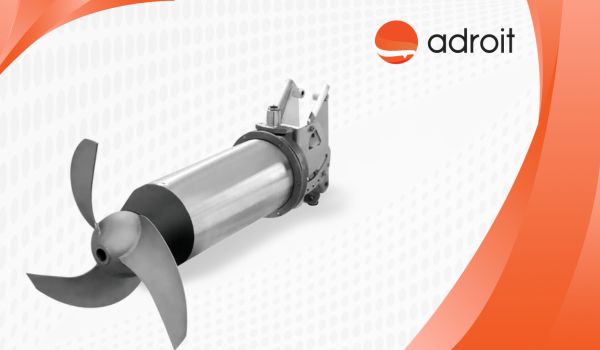
Submersible mixers are important for keeping the balance of oxygen distribution and making sure the solid waste remains suspended in lagoons. It is a heavy-duty machinery unit that is integrated underwater and forms a constant flow design that helps in the distribution of oxygen in the entire system.
Submersible mixers are developed with the following key features to optimize aerated lagoon performance:
- Energy-efficient Structure: The mixers utilize slow-speed impellers that maximize distribution, although minimizing power consumption.
- Corrosion-resistant materials: These mixers are made to resist harsh conditions of sewage treatment, ensuring durabiliy and dedicated performance over the period.
- Customized mixers: They are customized as per the specific geometry and flow rates of every lagoon, ensuring visual distribution and treatment efficiency.
Key Considerations for Sizing Submersible Mixers:
In aerated lagoons, proper mixing depends on multiple aspects, like:
- Target Velocity: The target velocity for mixing should be more than 0.15 m/s to control the solids deposit.
- Lagoon Volume and Desired Circulation Pattern: The size of a lagoon and the expected flow pattern should be evaluated when developing the mixer system.
- Computational Fluid Dynamics: The mixer design can be optimized to acquire the best possible distribution and oxygen transfers by using CFD.
The Role of Jet Aspirators in Aerated Lagoons
Jet aspirators are crucial for aerated lagoon systems as they blend and treat waste simultaneously. By building a high-velocity water jet that pulls in atmospheric air, they offer an efficient solution for treatment and mixing.
At Adroit, the design of jet aspirators has multiple benefits for wastewater treatment:
- No external blowers needed: It simplifies the system and lowers the maintenance expenses.
- Easy maintenance: Jet aspirators are low-maintenance in comparison to other aeration systems.
- Effective mixing and aeration: The high-velocity jets circulate oxygen evenly in the entire lagoon while keeping solids dispersed.
Design Factors for Jet Aspirators:
The invention of jet aspirators is based on key parameters to ensure the best performance:
- Power Input: 2 to 5 kW per 1000 m³ of lagoon volume.
- Oxygen Transfer Efficiency (OTE): OTE range of 0.8 to 1.2 kg O₂/kWh.
- Jet Velocity: Jet velocity should be between 3 to 5 m/s.
Sizing Your Aerated Lagoon System
Perfect sizing of the aerated lagoon is necessary to perform effective sewage treatment. To correctly size the lagoon, many key calculations need to be constructed like:
- Organic Load: The organic load is calculated using the formula:
Load (kg BOD/day)=Q×BODin×0.001\text{Load (kg BOD/day)} = Q \times BOD_{in} \times 0.001
(Q is the flow rate, and BODinBOD_{in} is the incoming BOD concentration) - Required Lagoon Volume:
V=LoadBOD Removal Rate (kg/m³/day)V = \frac{\text{Load}}{\text{BOD Removal Rate (kg/m³/day)}}
The BOD removal rate varies with temperature (e.g., 0.15–0.25 kg/m³/day in summer and 0.05–0.1 kg/m³/day in winter). - Hydraulic Retention Time (HRT):
HRT=VQHRT = \frac{V}{Q}
Seeking an HRT of 5 to 10 days for an effective treatment. - Aeration Requirements:
O2 Required (kg/day)=Load×1.5O_2 \text{ Required (kg/day)} = \text{Load} \times 1.5
Key Benefits of Aerated Lagoons with Adroit’s Submersible Mixers
Adroit’s aerated lagoon systems, improved with submersible mixers and jet aspirators, offer multiple key benefits like:
- The energy-efficient structures of our tool ensure low funds and operating costs.
- The systems are developed for effortless functioning with minimal intervention.
- Made to resist harsh conditions, our machinery is perfect for Indian environmental conditions.
- Our lagoon systems are modular, allowing for effortless growth as wastewater treatment requirements grow.
- Our systems can be powered by solar energy or hybrid grids, ensuring eco-friendliness and affordability
Applications of Aerated Lagoons with Adroit’s Technology
Aerated lagoon systems are favorably universal and can be used in different wastewater treatment applications, like:
- Wastewater treatment for towns and rural areas
- Industrial effluent polishing
- Seasonal wastewater treatment facilities
- STP retrofitting projects on available land.
Why Choose Adroit?
At Adroit, we offer complete services & solutions for the development and execution of aerated lagoons, and have powerful and efficient systems as per your needs. Our equipment, like submersible mixers and jet aspirators, has been successfully utilized in different wastewater treatment projects across India. With our expertise and dedication to higher performance, we ensure that your wastewater treatment system fulfills rules and standards while offering outstanding efficiency and reliability.
FAQS for Aerated Lagoon for Sewage Treatment: Role of Submersible Mixers/Jet Aspirators
Question 1. How is the perfect size of an aerated lagoon decided?
Answer: The Size of the lagoon is based on calculations of the organic load, needed lagoon volume, hydraulic retention period, and aeration needs. These elements ensure sufficient wastewater treatment and adherence to rules.
Question 2. What are the key benefits of Adroit’s aerated lagoons?
Answer: Our aerated lagoons are energy-efficient, need low maintenance, are long-lasting for harsh conditions, modular for future growth, and can be powered by renewable energy sources, making them affordable and eco-friendly.
Question 3. Why should we choose Adroit for the wastewater treatment needs?
Answer: Adroit offers complete services for aerated lagoon development and execution, backed by expertise and successful projects across the country. Our solutions ensure compliance with rules while providing high efficiency and trustworthiness in wastewater treatment.