
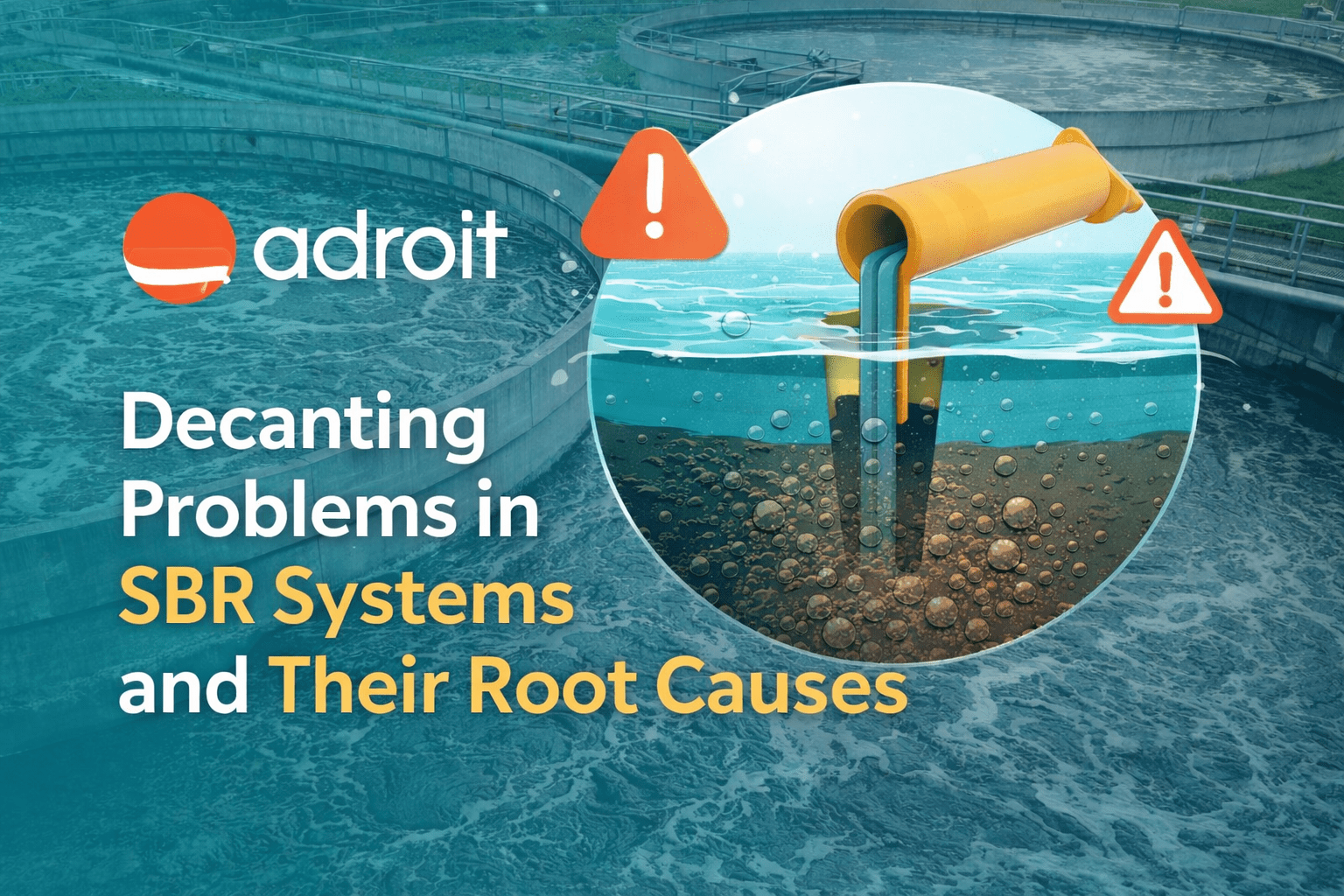

The SBR (Sequencing Batch Reactor) system is designed specifically to deliver high quality treated water in a compact system. But many plants struggles with issues related to decanting like sludge carryover, scum mixing and inconsistent discharge quality. These decanting problems reduces efficiency and increases operational costs. In this blog, Adroit will provide you with everything you need to know about the Decanting Problems in SBR Systems and their main causes.
What is Decanting in SBR Systems?
What are the Different Steps to Decanting in Schematic Batch Reactor SBR Systems? An SBR schematic batch reactor operates in 5 sequential and timed operations in a single reactor.
- Fill – Wastewater is added to the tank
- React – Wastewater receives air and undergoes biological treatment
- Settle – Biomass settles at the bottom of the tank under quiescent conditions (without movement)
- Decant – The clear, treated water is removed from the top of the tank without disturbing the settled sludge below
- Idle – Tank preparation for the next fill and cycle
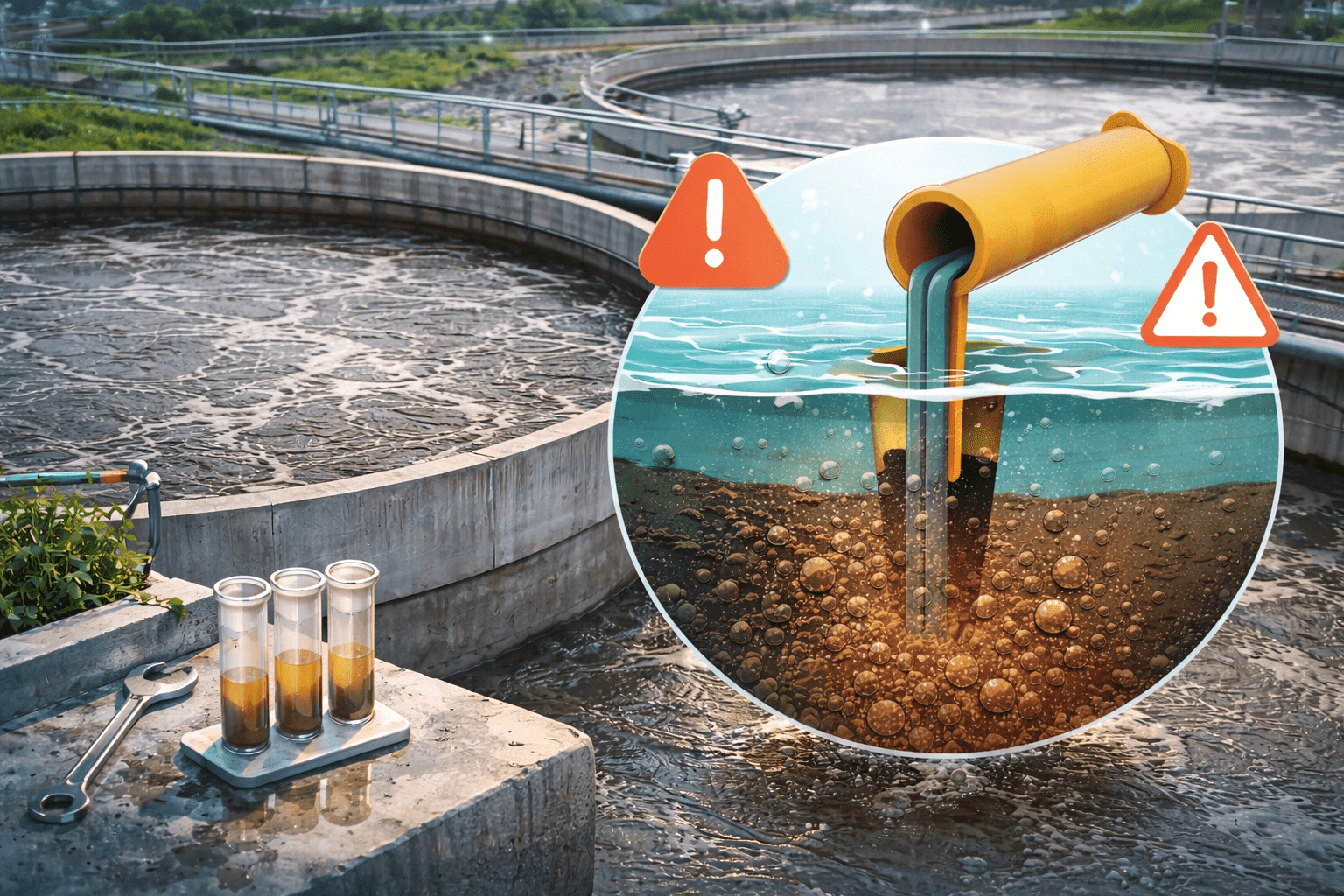
In the decanting step, clear water from the top of the tank is removed without disturbing the settled sludge under the water surface. Decanting operations are completed using specialized decanter systems (floating, fixed, and telescopic).
There are several important parameters that help define how effective decanting occurs including:
- Controlled decant rates (m³/h)
- Low turbidity (NTU)
- Stable sludge blanket heights
Any imbalance among these parameters will result in immediately noticeable performance issues.
Key Statistics on Decanting Failures in SBR Plants
Understanding the magnitude of the problem is important in order to prioritize corrective actions.
- 40% to 50% of complaints received about SBR systems can be directly attributed to malfunction or improper operation of the decanter.
- Sludge carryover due to poor decanting can increase to 25% to 35% of all Total Suspended Solids (TSS) present in the effluent stream.
- Re-treating of wastewater due to poor decanting can result in increases in energy consumption between 15% to 20%.
- Overall Operating and Maintenance (O&M) costs associated with SBR systems can be increased by 20% to 30%.
- Many SBR systems cannot consistently meet discharge limits due to inefficiencies associated with decanting.
These are the key statistics which shows that decanting is a key determinant of plant performance and compliance not just a minor operational detail.
Major Decanting Problems in SBR Systems
1. Sludge Carryover During Decanting
Uneven removal of sludge when withdrawing treated water is one of the most frequent decanting problems. Common causes include:
- Sludge blanket disturbance
- Too early start to decanting
- High decant rate
Consequences: Increases in TSS in effluent by up to 2 to 5 times, resulting in non-compliance and difficulties in subsequent processes.
2. Floating Sludge or Rising Sludge Blanket
Floating sludge is typically generated from denitrifying bacteria generating nitrogen gas bubbles that lift/slip on top of sludge particles.
- Approximately 30% of poorly controlled SBR systems have floating sludge.
- Floating sludge is most common in systems where there are longer settling times or greater amounts of nitrate present.
Consequences: Floating sludge is easily drawn into decanter, resulting in severe impairs of clarity in effluent.
3. Decanter Mechanism Failure
For uniform decanting, mechanical dependability must be established, mechanical failure of the decanting system may occur due to:
- Motor/actuator failure
- Seal failure
- Structural misalignment
Documented research indicates that mechanical failure is responsible for close to 20% of downtime in SBR systems.
4. Improper Decant Rate Control
Decant rates must be monitored and controlled accurately:
- Too fast: creates turbulence, disturbing sludge
- Too slow: reduces throughput and process efficiency
- Elevated decant rates increase turbidity of effluent up to 40% and reduce quality of effluent.
5. Air Entrainment and Vortex Formation
Poorly designed hydraulics or lack of anti-vortex features can introduce air into the decant flow through:
- Impacting settled sludge
- Reducing decanting efficiency
- Causing inconsistent discharge quality
6. Scum Carryover Issues
A decanter with poor scum removal capabilities can allow floating debris to enter the decanting process through:
- Increasing BOD/COD levels
- Causing surface fouling on downstream processes
Root Causes of Decanting Problems
1. Design-Related Issues
Many problems occur during the design phase and include:
- Selection of the wrong decanter type
- Poor hydraulic profile
- No anti-vortex or scum features
- Mismanaged systems will continue to be problematic even with improvements to operations.
2. Operational Errors
Even well designed systems can be negatively affected by incorrectly operated systems, such as:
- Incorrect timing of decanting cycle
- Decanting too soon
- Not having enough trained operators
Research indicates that 35-45% of decanting failures can be attributed to operational errors.
3. Process Imbalance
Biological imbalances can also contribute to decanting problems, due to:
- Fluctuating MLSS levels
- Poor sludge settling characteristics (higher SVI)
- Bulking sludge conditions
These issues are directly related to stability of the sludge blanket during decanting.
4. Maintenance Neglect
Decanter platforms need to be inspected and maintained on a regular basis, which includes monitoring for wears/tears or:
- Worn seals
- Corroded parts
- Defective actuators
Implementing preventive maintenance can decrease failures by 50%, yet is often overlooked.
5. Instrumentation & Automation Failures
Instrumentation & Automation Failure (Automation’s heavy reliance on) –
- faulty level sensors (level sensors that are not functioning properly)
- incorrect PLC programming (PLCs programmed incorrectly)
- timing mismatch (incorrect timing during operation)
The above factors can contribute to decanting at the wrong time. When this occurs the entire process fails.
Impact of Decanting Problems on Plant Performance
Consequences of decanting failure include:
- Effluent quality will worsen (BOD, COD or TSS will increase).
- Regulatory non-compliance (penalties and operator shut down period).
- Increased sludge handling costs and disposal costs.
- Reduced efficiency and capacity utilization of the overall plant.
Proven Solutions to Overcome Decanting Issues
1. Optimized Decanter Design
The right decanter should be used:
- Floating Decanters accommodate dynamic water levels.
- Telescopic Systems allow for controlled water withdrawal
- Anti-Vortex Devices will improve performance
2. Smart Automation & Controls
Advanced control systems (SCADA/PLC based) for reliable process control include:
- Allow for real time data collection of the sludge blanket.
- Provide a means to automatically adjust the decanting rate.
3. Proper Cycle Time Optimization
Properly balancing settling and decant time is critical:
- Decanting should only occur after complete sludge has settled.
- Extended idle times can lead to denitrification.
4. Regular Maintenance Protocols
Follow a recurring maintenance program:
- Use of general checklists to evaluate the condition of Mechanical components.
- Schedule routine service of all mechanical components.
- Use performance data to predict when maintenance will occur.
5. Operator Training & SOP Implementation
- Operator training on process dynamics is important.
- Standard Operating Procedures (SOPs) should be implemented.
- Operators should be given the means to conduct rapid troubleshooting and corrective actions.
Why Choose Adroit for SBR Decanting Solutions
Adroit has over 30 years of experience in providing dependable wastewater treatment solutions, combining engineering excellence and applied field knowledge.
- Wastewater treatment equipment is designed and manufactured in house to meet our client’s needs.
- We focus on innovation and create resilient systems.
- Our ISO 9001:2015 Quality Management System ensures that we continually improve our services.
- Customized solutions for both municipal and industrial applications.
- We ensure that decanting systems are efficient and also maintainable, durable, and future proof.
Conclusion: Turning Decanting Challenges into Operational Efficiency
To sum up everything that has been stated so far, the above given information on the topic “Decanting Problems in SBR Systems” states that decanting problems in SBR systems are common but they are also predictable and preventable. Understand the root causes can help to significantly improve performance and reliability. If you want to learn more details, contact Adroit by dialing +91 70248-48383 or emailing your queries to [email protected].
FAQs About Decanting Problems in SBR Systems
What are the most common decanting problems in SBR systems?
Common issues that can occur when decanting from an SBR include sludge carryover, floating sludge, scum entering, improper decanting rates and mechanical failure of decanters which affect both the quality of the effluent produced and overall performance of the SBR system.
What causes sludge carryover during SBR decanting?
Sludge carryover is typically caused by excess decanting velocity, insufficient time given for the sludge to settle, denitrification causing the sludge to rise, and/or disturbance within the sludge blanket during withdrawal.
What is the ideal decanting rate in an SBR system?
The ideal decanting velocity varies based on the design and size of the tank, but should always be at a very slow, controlled rate to minimize turbulence and/or disturbance to the sludge located in the bottom of the decanting tank.
What maintenance is required for SBR decanters?
Preventative maintenance performed on decanters include checking the condition of seals, actuators, and moving parts; inspecting for corrosion; and ensuring that the decanter is properly aligned and operating smoothly.
What are the signs of decanter malfunction in SBR systems?
Signs of a decanter malfunction in an SBR include inconsistent effluent quality, visible sludge present in effluent discharge, audible noises from a decanter, uneven decanting process and numerous system alarms indicating an issue with one of the components of the decanter.