
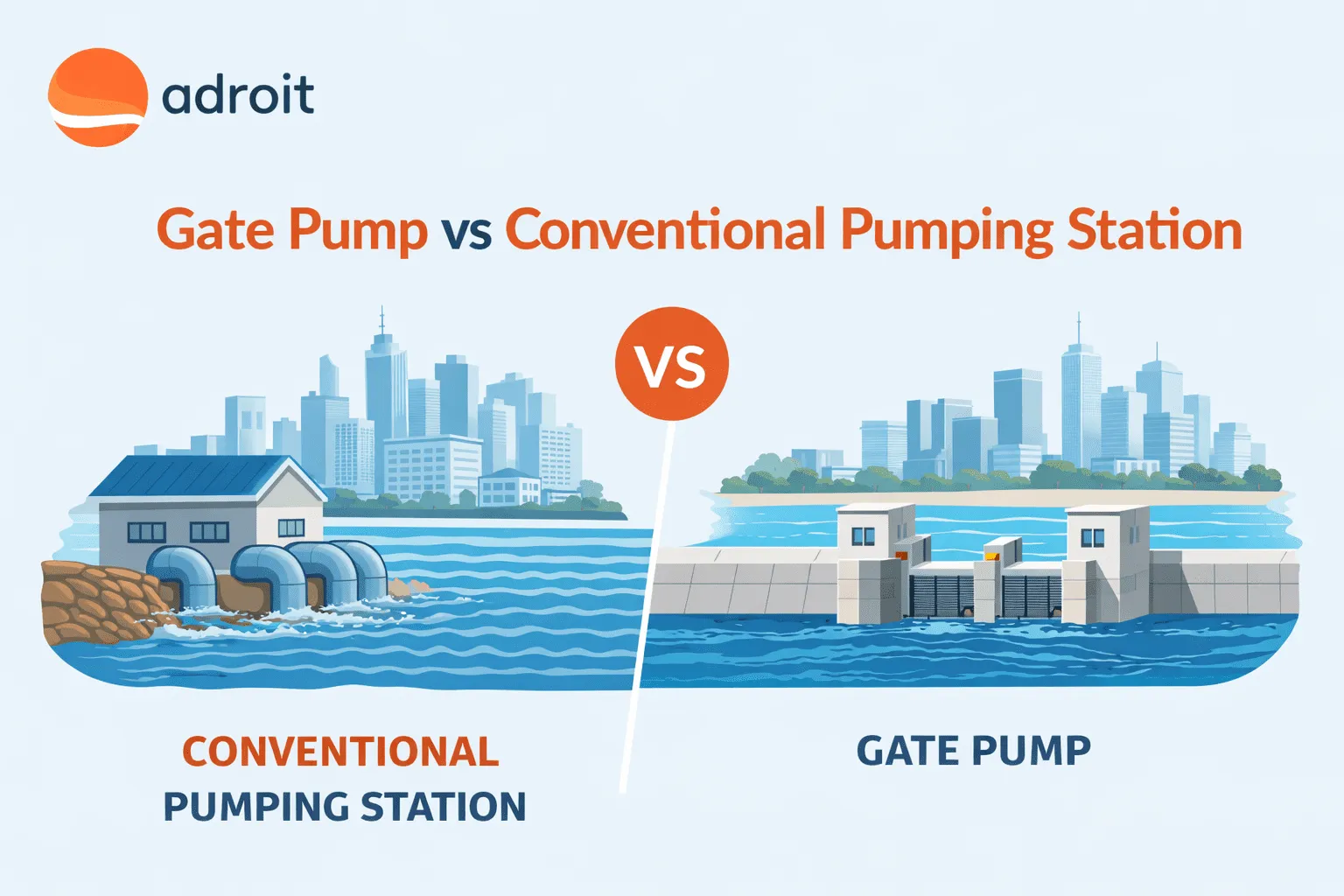

Flooding has been an increasing problem all around the globe for coastal cities. Being affected by rising sea levels, extremely hard rains or tidal flows can frequently produce extensive urban flooding, as traditional drainage systems are unable to cope with extreme rainfall and overflow water from the rising tide. For this reason, conventional pump stations are frequently used to help manage stormwater, but due to tidal or storm surge influences, they usually find it difficult to work under these conditions.
Gate pumps provide a modern alternative to manage the excessive amounts of water produced by flooding. Gate pumps combine the functions of the pump and an automated flood gate into a single unit. This combination offers improved flood protection, increased drainage efficiency and less infrastructure required than conventional pump stations.
Engineers and city planners need to understand the differences between gate pumps and conventional pumping stations to build resilient flood management systems. In this blog, Adroit will provide you with everything you need to know about Gate Pump vs Conventional Pumping Station and why gate pumps are a better solution for flood prone coastal cities.
What is a Gate Pump?
A gate pump is designed to manage flood control by combining the work of a sluice gate and a pump into one piece of equipment.
Key Features of Gate Pumps
- It combines the function of a water-control gate and pump in one piece of equipment.
- When there is a high tide, it prevents tidal backflow through the gate.
- During extreme rainfall, it can pump away stormwater quickly.
- It requires a smaller amount of infrastructure than a traditional pumping station.
- It is appropriate for use as part of an effective coastal drainage system or as a flood control solution.
Basic Operation Concept
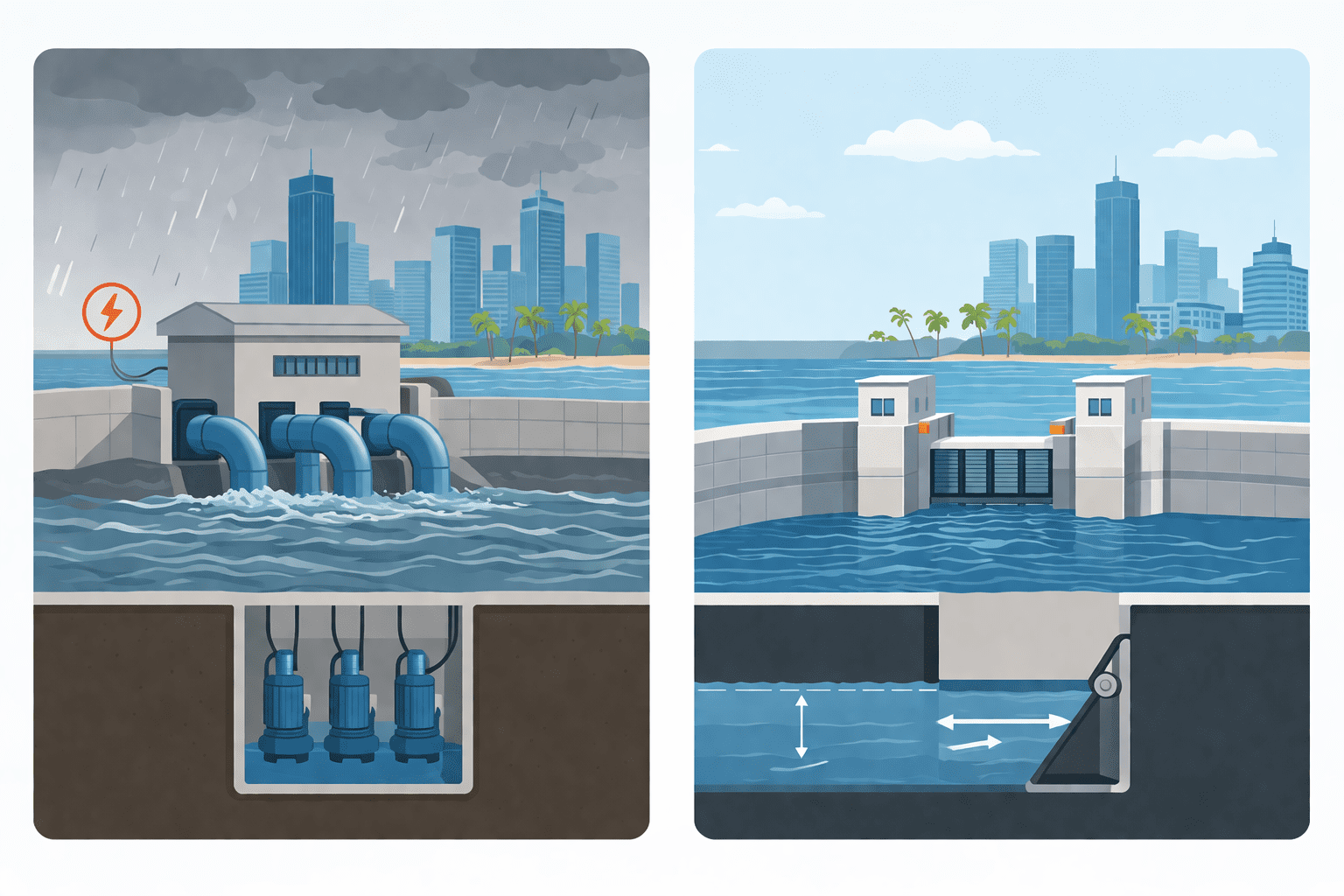
The gate allows gravity to cause the water to flow through it on a normal day. During prolonged periods of heavy rainfall or when water has accumulated because of a high tide condition, the gate will keep the excess water out while the pump will discharge some of that water through the pump.
What is a Conventional Pumping Station?
A conventional pumping station is a piece of infrastructure that facilitates the movement of either stormwater or wastewater from their respective areas of lower elevation to higher elevation points for discharge into rivers, canals or oceans.
Key Features of Conventional Pumping Station
- Pump sump or wet well
- Submersible pumps or centrifugal pumps
- Intake structures and intake screens
- Control panels and electrical control systems
- Discharge pipes
- Separate floodgates or check valves
Conventional Pumping Station Operations
Conventional pumping station operations begin when stormwater enters the pump sump/wet well. As a result of one or more storm events, the water level rises in the sump to a level that exceeds a predetermined pump activation level. Activation of the pumps causes water to be discharged into the receiving body of water.
However, when there is a high tide, it can be very difficult to discharge water from the conventional pumping station, thus increasing the likelihood of urban flooding.
Working Principle of Gate Pumps
Waygate pumps are designed for effective operation in areas with both tidal control and stormwater management.
Steps of Operation
- In a natural state, the gate is normally open and allows water to flow freely.
- When water levels increase from rainfall, the pump system turns on.
- When there is backflow from the tide, the gate closes automatically to keep saltwater from entering the drainage system.
- The pump continues to discharge storm water until the water level is back to normal.
Benefits of the Working Principle
- Prevent saltwater from getting into the system
- Allows quick and efficient discharge of storm water
- Enhances flood control effectiveness
Working Principle of Conventional Pumping Stations
Conventional pumping stations generally use an old-fashioned approach to stormwater management.
Basic Operation Steps
- Stormwater flows into wet wells or sumps.
- The pump system turns on when there is enough water.
- Water is pumped from the discharge pipe to the river, canal, or ocean.
- Backflow from the floodgates may be reduced using separate flood control devices.
Limitations
- Need for additional flood control devices
- Requires larger structures to accommodate additional devices
- Increased construction and maintenance costs
Key Differences: Gate Pump vs Conventional Pumping Station
| Parameter | Gate Pump | Conventional Pumping Station |
| Structure | Integrated gate and pump system | Separate pump station and flood gate |
| Space Requirement | Compact design | Requires a larger infrastructure |
| Flood Protection | Prevents tidal backflow and pumps simultaneously | May require additional flood gates |
| Installation Cost | Lower civil construction cost | Higher infrastructure cost |
| Operational Efficiency | Faster response during flooding | Slower response due to separate systems |
| Maintenance | Fewer components and a simpler structure | Multiple mechanical and civil components |
| Energy Efficiency | Pumps operate only when necessary | Higher energy usage during continuous operation |
Why Gate Pumps Are Ideal for Flood Prone Coastal Cities
- Minimalisation of Tidal Backflow Issues
Fuelled by tidal backflow associated with the sea to the land, one of the significant problems facing urban drainage systems is properly functioning drainage during tidal flows. Gate pumps use integrated seals to automatically close during times of high tide, thus eliminating the tidal backflow issue.
- Size & Accessibility of Equipment
Many coastal urban centres have limited spaces for constructing large infrastructure. Gate pump systems integrate various functions, so the need for larger pumping stations is greatly reduced.
- Efficiently Discharging Surface Water
Since gate pumps integrate pumping and flooding, they react much faster than conventional pumps in response to rising water levels and efficiently discharge surface water.
- Reduced Civil Works
Conventional pump stations typically require a significant amount of civil work such as pump houses, wet wells, and other floodgates. Gate pumps reduce civil work. They are significantly easier to install.
- Flood Reduction Ability
Gate pumps are built to withstand high-volume winds (e.g., hurricanes, tornadoes) and inundation from heavy rain and storm surges which makes them highly effective as flood loss control tools.
Applications of Gate Pumps
Situations Where Gate Pumps Are Used
Gate pumps are typically used in these types of situations:
- Coastal urban drainage systems
- Stormwater pumping stations
- River outfalls and canal discharge locations
- Flood protection infrastructure
- Industrial locations near the coast
- Port and harbour drainage systems
Key Factors to Consider When Selecting Gate Pumps
Factors to Remember When Selecting Gate Pumps
The following factors are important to think about when you select your Gate pump:
- Pumping capacity and flow rates
- Variance between tidal elevation
- The conditions of the site as well as the available space
- Corrosion resistance due to the marine environment
- The need for automation/controls
- Ease of maintenance
Future of Urban Flood Management
The Future of Urban Flood Management
As climate change causes more frequent events of extreme weather across the country, many cities will begin to put more money towards smarter and stronger flood control infrastructure.
Trends in the Future of Urban Flood Management Include:
- Smart drainage systems with real-time monitoring and reporting systems.
- Automated pumping and gate operation.
- The integration of Urban Flood Forecasting with Coastal Infrastructure Planning.
- Utilising climate-resilient Coastal Infrastructure Designs.
Conclusion: Why Gate Pumps Are a Smart Choice for Coastal Flood Control
To sum up everything that has been stated so far, the above information on the topic “Gate Pump vs Conventional Pumping Station” states everything you need to know about why Gate Pumps are a Better Solution for Flood Prone Coastal Cities. If you want to learn more about the Gate Pump and Conventional Pumping Station or want to explore wastewater treatment equipment, visit Adroit’s website today or contact us by dialling +91 70248-48383 or emailing [email protected].
Frequently Asked Questions (FAQs)
Question. How is a gate pump different from a conventional pumping station?
Answer. Traditional pump stations utilise floodgates and separate pump units to manage storm water while gate pumps support both functions in a single unit, creating a more compact, more efficient design than traditional pump stations for managing flood water events and better supporting coastal cities in managing their flood risk.
Question. Are gate pumps more efficient than pump stations?
Answer. Gate pumps have lower energy consumption because they are used only when needed based on both flood runoff and tidal backflow. Under typical conditions, storm water that would flow through the station remains flowing through the station to the outfall without any demand from the pump.
Question. Why are gate pumps suitable for cities with coastlines?
Answer. Gate pumps have the ability to move storm water to outfall locations during intense rainfall, preventing back flow of water into the coastal city due to the tides and thereby allowing the coastal city to manage the effects of rising sea levels and storm surges.
Question. What areas have gate pumps?
Answer. Gate pumps can typically be found in coastal cities in the storm water drainage systems, flood control systems, river outfalls, and in urban drainage systems in flood prone areas.
Question. Are gate pumps suitable for urban drainage systems?
Answer. Yes. Gate pumps are generally used for urban drainage because they have a small footprint and can provide both functions in one device which are ideal for urban sites where space is at a premium and the flooding potential is very high.