
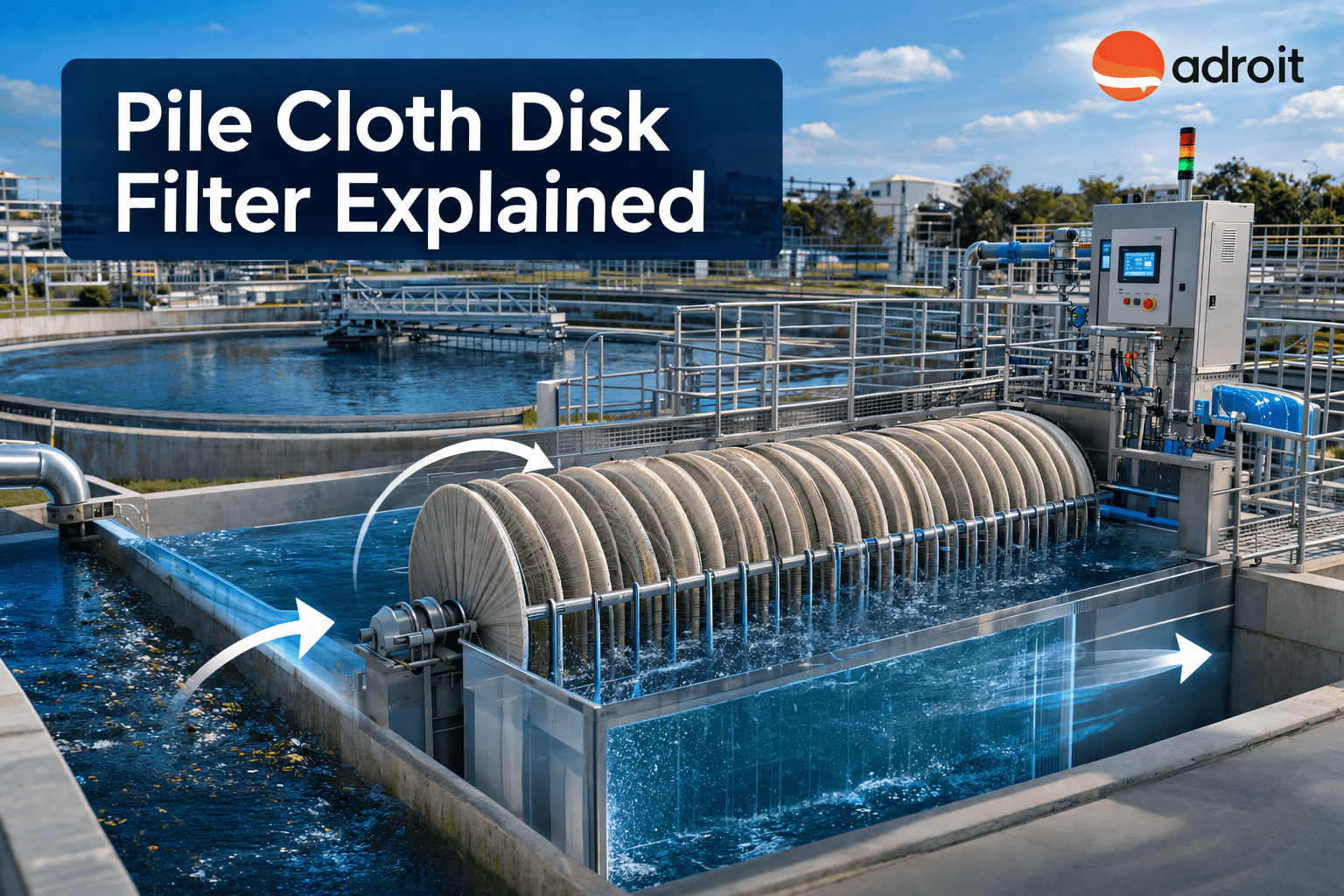

In todays wastewater plants, it is crucial to meet discharge and water reuse standards to achieve low TSS and turbidity after after secondary treatment. Systems like Activated Sludge Process can remove most organic pollutants but fine suspended particles often remain in the effluent. A Pile Cloth Disk Filter is an efficient tertiary filtration system that can filter the remaining solids. In this blog, Adroit will provide you with everything you need to know about Pile Cloth Disk Filter (GDisk®), how it achieves low turbidity / low TSS polishing and where it fits after secondary treatment.
What is a Pile Cloth Disk Filter?
A cloth filter disk pile is a tertiary wastewater treatment system with high efficiency that can remove TSS (suspended solids), phosphorus and algae by using rotating submerged cloth covered disk filters, which act as a “free-fibre” pile cloth filtering medium, providing an expansive surface area for deep filtration, which normally results in the production of effluent (<5mg/l TSS).
Key Features of Pile Cloth Disk Filters
- Technology: They employ a brush-like, pile fabric to capture tiny suspended particles as they flow through the system, thus retaining them within the cloth fibres.
- Process: Pile cloth disk filters use a gravity-driven, submerged operating system and continuously operate, meaning the filtration aspect of the unit will still work while the unit is undergoing a backwashing cycle.
- Applications: Commonly used for tertiary treatment of municipal and industrial wastewater, as well as removal of phosphorus and water reuse.
Benefits:
- High performance: TSS and phosphorus concentrations are very low, e.g., 0.1 mg/L.
- Cost-Effective & Space Efficient: They use less energy and occupy a smaller footprint than sand filters (less space by as much as 75%).
- Easy to Operate: They are simple, automated and require low maintenance.
Where It Fits After Secondary Treatment?
A regular wastewater treatment process would look something like this:
- Primary Treatment
- Secondary Treatment, which may include (ASP, SBR, MBBR)
- Tertiary Filtration, which takes place in a GDisk® stage
In effluent after secondary clarification, suspended fine solids in the wastewater may still substantially impact:
- Turbidity
- Suitability for reuse
- Compliance with discharge requirements
The GDisk® System is placed immediately after the secondary clarifier to “polish” the final effluent and to help achieve:
- Stable low TSS
- Clarity
- Improved performance for disinfection at downstream facilities
The brochure highlights that the GDisk® System is intended for the final removal of SS in both sewage and wastewater treatment facilities in the tertiary treatment process.
How Pile Cloth Disk Filters Achieve Low Turbidity & Low TSS
- Fibre Filter Cloth Technology
GDisk® utilises a filter cloth made of fibre blended with heat-fused fibres to produce low-melting-point fibre yarns.
Benefits:
- High mechanical strength
- Filtration stability
- Long service life
- Fine particulate filtration efficiency
- Thus allowing GDisk® to operate via:
- Surface filtration
- Depth filtration
- Continuous Backwashing Filtration System
One of GDisk®’s greatest advantages is that backwashing can occur while the unit is still filtering.
As indicated in the process diagram, the backwash mode can be:
- Automatically activated by level sensors and a timer
- Utilize low pressure suction backwashing
- Accomplish cleaning the filter cloth without interruption
- This results in:
- Consistency of effluent quality
- No interruption of the process
- Less operator dependency
- Innovative Suction Backwashing Device
The GDisk® design includes a double-sided, protruding slot siphon for low-pressure backwashing. An international patent is pending on this suction backwash device.
Benefits of this invention include:
- Vacuum suction for total contaminant removal
- Lower backwash wastage (estimates 20% reduction in backwash consumption)
- Less energy consumption
- Lower O&M costs
- Combined Filtration Process
GDisk® provides accelerated filtration to produce more stable effluent with smaller particles, thus allowing continued high filtration rates for improved polishing.
Design Parameters That Matter for Buyers
When deciding on the purchase of a GDisk® Pile Cloth Disk Filter for the purpose of tertiary treatment, the buyer should pay close attention to the various technical specifications which have a direct effect on performance, efficiency and long term reliability.
- Hydraulic Loading Rate
The filtration system must adequately handle peak and average flows to properly load the filters so as to effectively remove fine particles and maintain stable low TSS and turbidity levels.
- Influent TSS Quality
The GDisk® Filter should be utilised as a polishing filter after secondary treatment and consistent upstream clarification will avoid overloading of cloth filter material and the need for more frequent backwash cycles.
- Filtration Area & Capacity
The GDisk® Filter model selection should consider both the required m³/day capacity of the filter and planning for future expansion and redundancy requirements.
- Cloth Media Durability
Proper cloth filter media must be manufactured from high quality fiber to ensure stable effluent quality is maintained, mechanical strength remains intact, and therefore the operational life of the filter is significantly extended.
- Backwash Efficiency
An automatic low pressure suction backwash system reduces water loss from backwashing, energy consumption for pumping water, and operational costs.
- Automation & Control
The installation of PLC integration/sensor-based backwash control and automated rotation of each filtration disk will increase the reliability of the filtration process while reducing operator dependence.
- Footprint & O&M Costs
A compact footprint, low headloss and reduced power consumption, combined with a low maintenance operation will result in much lower overall lifecycle costs for the GDisk® Filter.
Applications in Municipal & Industrial Plants
GDISK Pile Cloth Disk Filter is utilised after secondary treatment for tertiary polishing in order to eliminate low suspended solids (TSS) and turbidity from the effluent.
Municipal Waste Water Plants
GDISK can be utilised for final effluent polishing in STPs to assist with discharge limit compliance and provide higher quality water reuse solutions.
Industrial Waste Water Treatment Plants (WWTPs)
GDISK can be utilised for the removal of all very fine suspended solids to provide consistent and stable compliance for recycling and reuse applications.
Reclaimed Water for Irrigation Applications
GDISK provides excellent reclaimed water for irrigation, provides better quality cooling tower water and increases clarity of processed wash waters.
Design and Capacity Specifications
Adroits’s GDisk® Pile Cloth Disk Filter is available in multiple models:
| Model | Disk Diameter | Filtration Area | Capacity (m³/day) |
| GDisk® 900 | 0.9 m | 0.67 m²/disk | 10–900 |
| GDisk® 1200 | 1.2 m | 1.46 m²/disk | 110–2,920 |
| GDisk® 1800 | 1.8 m | 2.5 m²/disk | 200–5,000 |
| GDisk® 2200 | 2.2 m | 5.25 m²/disk | 400–32,500 |
| GDisk® 3000 | 3.0 m | 10.5 m²/disk | 800–63,000 |
Each model can be equipped with up to 24 disks depending on capacity needs.
This modularity allows:
- Small STPs
- Medium municipal plants
- Large wastewater treatment facilities
Comparison: GDisk® Pile Cloth Disk Filter vs Other Tertiary Filtration Systems
| Parameter | GDisk® Pile Cloth Disk Filter | Rapid Sand Filter | Pressure Sand Filter |
| Operation | Continuous filtration with automatic backwash | Batch operation with periodic backwash | Pressurised, periodic backwash |
| Footprint | Compact, space-saving | Larger civil area | Moderate |
| Energy Use | Low (gravity-based) | Moderate | Higher (requires pumps) |
| Effluent Quality | Low TSS & low turbidity | Moderate polishing | Moderate polishing |
| Automation | Fully automatic | Semi-automatic | Semi-automatic |
| Best For | STPs, ETPs, reuse projects | Conventional tertiary use | Industrial polishing |
Advantages of Pile Cloth Disk Filters
Self-Operation Against Changes in Inflow
Automated disk motor control & backwash cycles through stabilised performance with varying flow and load conditions.
Consistent Effluent Quality Control
Ensured consistency of effluent quality through optimised low rates of filtering.
Contingency Plan for Events of High Concentration
20% reserve of filtering area, with backup equipment for chemical and backwashing pumps.
Compact Size
Compared to Conventional Sedimentation Tanks or Sand Filters, GDisk® Provides:
- Significantly smaller footprint
- Fully submerged in the ground
- Smaller site/civil construction needs
How Adroit Brings GDisk® to Modern Treatment Plants
At Adroit, we are committed to:
- Resolving drinking water issues
- Enhancing black/grey water processing
- Assisting river/lake revitalisation efforts
- Creating reuse and sustainable water systems
We deliver first-class options for cities and industries to obtain low TSS (total suspended solids), low turbidity and reliable levels of service for many years through the installation of our GDisk® Pile Cloth Disk Filter systems into their wastewater treatment operations.
Frequently Asked Questions About Pile Cloth Disk Filter
Question. What maximum amount of turbidity can your disk filter achieve?
Answer. The maximum turbidity attainable from a well-constructed system would be less than 2 NTUs when the discharge from the disk filter is continuously subjected to similar conditions downstream and has demonstrated adequate upstream performance.
Question. Can a pile cloth disk filter be utilised to recycle water?
Answer. Yes, pile cloth filters commonly are used for recycling water in irrigation reuse and industrial recycle applications where TSS is low and clarity is enhanced.
Question. What should be among the important design criteria that influence selection?
Answer. The following are some design criteria affecting your selection:
- Hydraulic loading rate
- Influent TSS concentration
- Cloth arm pore spacing
- Type and frequency of backwashing and required area
Question. How does a pile cloth disk filter differ from a rapid sand filter?
Answer. Key differences are as follows:
- Pile cloth filters provide continuous filtration with automatic backwashing
- They require less floor area
- They generally consume less energy than rapid sand filters
Question. What types of businesses get pile cloth disk filters?
Answer. A sampling of types of companies that regularly use pile cloth filters includes: municipal STPs, textile ETPs, food and beverage production, pharmaceutical and chemical manufacturers.