
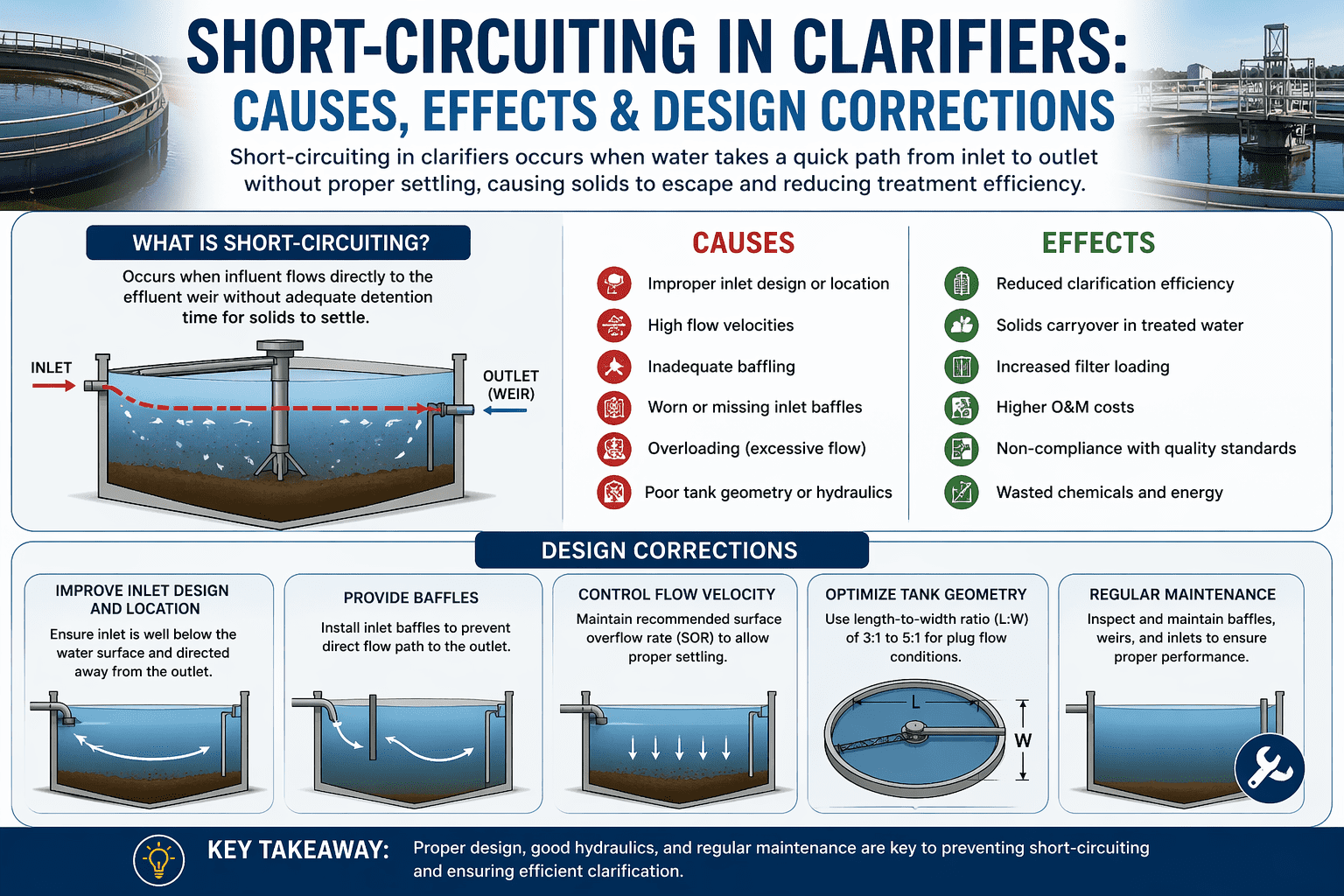

A key component in any wastewater treatment plant is the clarifier. Its function is to remove solids from treated water, thus removing them from the wastewater before releasing it into the environment. Yet, well-designed clarifiers can become less effective through Hydraulic Inefficiencies, a prime example of which is Short-circuiting. There are several wastewater engineering studies that point out that if the hydraulic flow distribution is poor it may lead to a reduction of between 50 to 70% in effective hydraulic retention time and consequently of process performance. If short-circuiting takes place in a clarifier, some of the incoming wastewater by passes the zone of settling of solids and, therefore, the quality of the discharged effluent is poor.
Given the current stringent BOD, COD and TSS compliance standards that we face today it is vital to address these kinds of inefficiencies. It is at this stage that we encounter service providers that are experts in providing diagnostics and engineering solutions, such as Adroit Water Technologies.
What is Short-circuiting in clarifiers?
Short-circuiting means the bypassing of effluent from the clarifier inlet to the clarifier outlet without sufficient settling of solids. In this phenomenon, preferred flow paths are created through which the water flows without evenly distributing throughout the tank.
Ideal Clarifier Conditions:
- Even distribution of the incoming water flow
- Sufficient retention time and contact time of the solids
- Clear and stable effluent
- Short-circuiting Conditions:
- Uneven, channelized flow paths
- Shortened retention time
- Escape of suspended solids with the effluent
Short-circuiting “shortens” the treatment process that has been put in place and consequently produces reduced output quality.
How does short-circuiting happen? Hydraulic Behavior
Water always travels along the path of least resistance. When a clarifier is not hydraulically balanced some parts are moving at a fast pace and others are stagnant.
Some of the main hydraulic problems are:
- Formation of flow channels between inlet and outlet
- Formation of dead zones in which the water remains stagnant
- Velocity profiles over the whole width and depth of the tank vary significantly
- The effective detention time within the tank decreases dramatically
For instance a clarifier with a 3-hour designed retention time might have effective retention times of less than 1 hour due to short-circuiting. This obviously compromises settling efficiency and overall plant operation.
Causes of short-circuiting in clarifiers
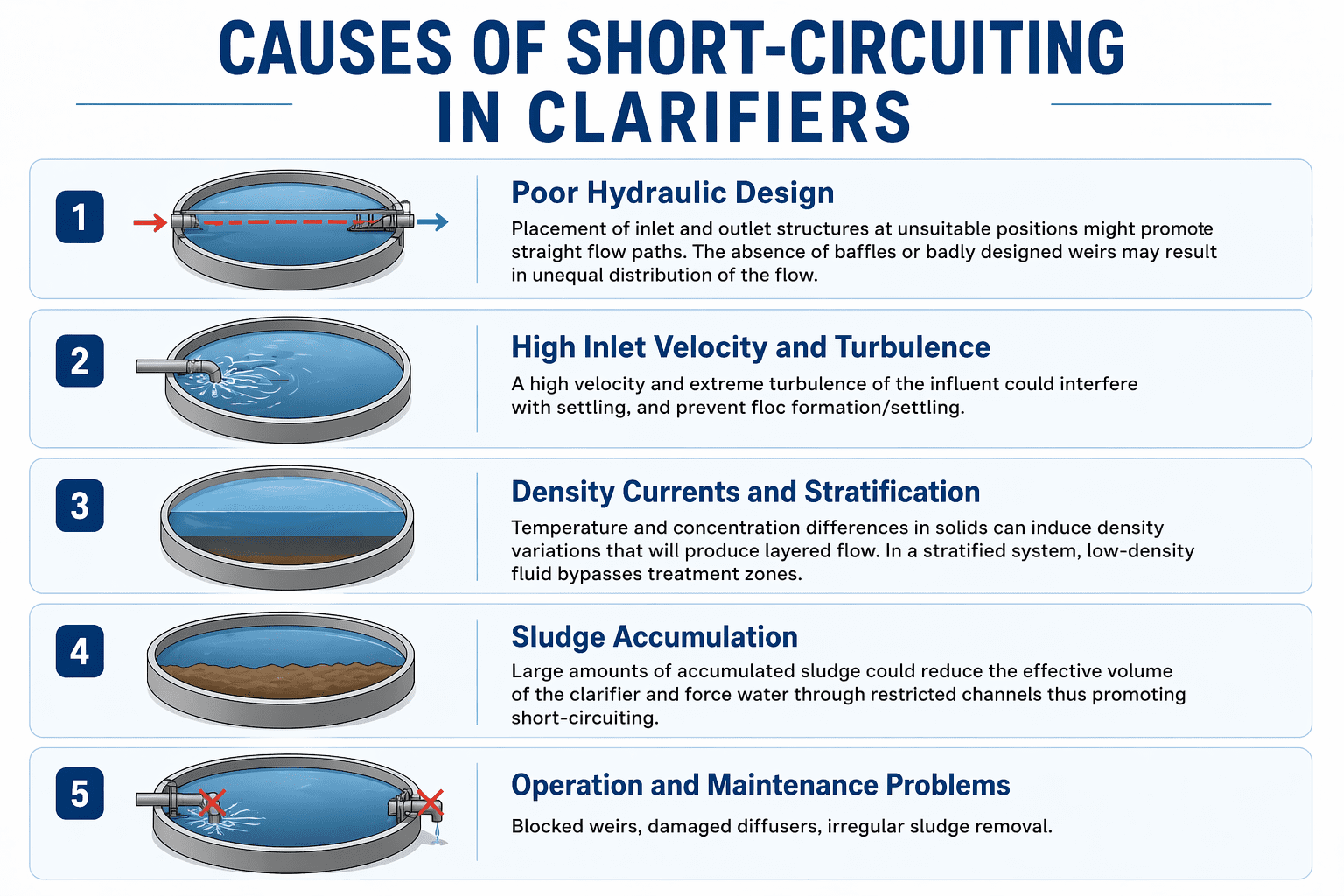
- Poor Hydraulic Design
Placement of inlet and outlet structures at unsuitable positions might promote straight flow paths. The absence of baffles or badly designed weirs may result in unequal distribution of the flow.
- High Inlet Velocity and Turbulence
A high velocity and extreme turbulence of the influent could interfere with settling, and prevent floc formation/settling.
- Density Currents and Stratification
Temperature and concentration differences in solids can induce density variations that will produce layered flow. In a stratified system, low-density fluid bypasses treatment zones.
- Sludge Accumulation
Large amounts of accumulated sludge could reduce the effective volume of the clarifier and force water through restricted channels thus promoting short-circuiting.
- Operation and Maintenance Problems
Blocked weirs, damaged diffusers, irregular sludge removal.
Impacts of Short-Circuiting in Clarifiers
Short-circuiting in wastewater clarifiers has both short and long term impacts, namely;
- Low Settling Efficiency: The flow bypasses the clarifier tank, particles do not have enough time to settle, and as a result poor solid-liquid separation occurs.
- Elevated Pollution levels in effluent: The effluent leaving the clarifier will contain high concentrations of TSS, BOD, and COD and will therefore likely not meet effluent standards.
- Sludge Carryover: The unsettled sludge will pass out of the clarifier with the effluent, making the effluent cloudy and placing strain on downstream processes.
- Higher Operating Costs: The treatment plant will likely increase chemical dosage and/or aeration to offset poor clarifier performance, therefore increasing operating costs of chemicals and electricity.
- Environmental and Regulatory Risks: Discharge above regulatory standards may result in fines, environmental pollution and reputational damage.
Indications of short-circuiting:
Early indications that a clarifier may be experiencing short-circuiting will help to mitigate the downstream impacts of poor performance. An inspection of the clarifier will highlight;
- Uneven sludge blanket levels
- Sharp increase in effluent turbidity
- Appearance of fine particles near outlet
- Reduced detention time
- Visible flow patterns or current in the clarifier.
Advanced diagnostic tests like dye tracing and tracer studies are valuable for defining flow patterns accurately.
Design measures to prevent short-circuiting:
- Installation of Baffles:
Baffles can be installed to help redirect flow, smooth out turbulence and force the wastewater to flow through the full volume of the clarifier.
- Optimal Inlet Design:
Properly designed inlet structures reduce incoming velocities and aid uniform distribution of the wastewater throughout the clarifier.
- Efficient Weir Design:
A uniform weir across the length of the clarifier provides even effluent withdrawal, and thus avoids the concentration of flow in specific zones, which could contribute to short-circuiting.
- Flow Equalisation:
This involves the use of an equalization tank to smooth out the input flow into the treatment process, and to provide a stable rate of flow into the clarifier, thus avoiding hydraulic surges.
- Timely Sludge Removal:
A regularly de-sludged clarifier with efficient removal of solids will maintain sufficient capacity.
Modern Clarifiers and the Future:
A modern treatment plant will look to the following for efficient hydraulic operation:
- Computational fluid dynamic modeling for improved design
- Real-time monitoring of operating parameters
- Automatic sludge removal systems
- Intelligent flow distribution technologies
- AI-based maintenance prediction
Advanced diagnostic tool manufacturers like Adroit Water Technologies can identify, design and implement solutions to hydraulic challenges in clarifiers.
Comparison Table: Normal vs Short-Circuiting Clarifier
| Parameter | Properly Functioning Clarifier | Short-Circuiting Clarifier |
| Flow Pattern | Uniform and evenly distributed | Channelized and uneven |
| Retention Time | Designed HRT maintained | Significantly reduced |
| Settling Efficiency | High | Poor |
| Effluent Quality | Clear and compliant | High TSS, BOD, COD |
| Sludge Behavior | Stable and controlled | Sludge carryover |
| Operational Cost | Optimized | Increased |
Case Example: Overcoming Short-Circuiting
A factory struggled with high turbidity in their wastewater discharge and non-compliance with discharge regulations.
Problem: Poor distribution of incoming flow; solids carryover; decreased retention time.
Solution by Adroit Water Technologies: Internal baffles; redesigned influent distributor; improved sludge removal design.
Result: Better flow distribution; dramatically decreased TSS; stable discharge compliance. This example shows that fundamental design alterations are crucial for optimal clarifier performance.
Future Trends in Clarifier Design and Optimization
The industry is moving towards intelligent, optimized treatment systems:
- IoT enabled clarifiers with real-time monitoring;
- AI powered hydraulic optimization; energy efficient, smaller footprint clarifiers; and integration into comprehensive water management systems.
These developments will be key to improved efficiency and lower operational costs for industries.
FAQs For Short-Circuiting in Clarifiers:
What are the common causes of short-circuiting in clarifiers?
Short-circuiting is primarily caused by inefficient hydraulic design, high influent velocity, sludge blanket build-up, and irregular influent flow. Each of these conditions causes shortcuts in the clarifier, decreasing effective treatment time and settling performance.
How does short-circuiting impact the quality of effluent?
When short-circuiting occurs in a clarifier, suspended solids in the wastewater have less time to settle and are carried along with the effluent. This leads to higher levels of TSS, as well as an increase in BOD, and COD which contribute to poor water quality and possible violations of regulatory standards.
What are some indicators of short-circuiting in a clarifier?
Short-circuiting can be observed through signs of unequal sludge blankets, elevated turbidity and shortened retention times. Dye and tracer studies offer a more precise means of characterizing flow patterns within the clarifier.
What are some of the most effective ways to prevent short-circuiting?
Some of the most effective methods for preventing short-circuiting include baffles, optimization of inlet/outlet configuration, and sludge levels, along with a steady flow rate. Automation and sophisticated monitoring are other efficient technologies that can help prevent short-circuiting by maintaining stable operating conditions.
Why should you use Adroit Water Technologies for clarifier optimization?
Adroit Water Technologies offers unique, individualized solutions with advanced technology and engineering capabilities. Our expertise ensures enhanced clarifier performance with minimized operational costs and strict environmental regulation adherence, and our experience provides a trustworthy source of guidance during wastewater treatment processes.
Conclusion
Short-circuiting in clarifiers can be a critical and detrimental issue for any wastewater treatment facility. The negative impacts of this can range from diminished retention times to an increase in pollutants and can be an extremely costly and environmentally detrimental problem. Fortunately, with precise design revisions, comprehensive monitoring, and an experienced guide from an industry leader, like Adroit Water Technologies, short-circuiting can be successfully eliminated, resulting in increased operational efficiencies and adherence to environmental guidelines. Contact Adorit by dialing +91 70248-48383 or emailing your queries to[email protected].