
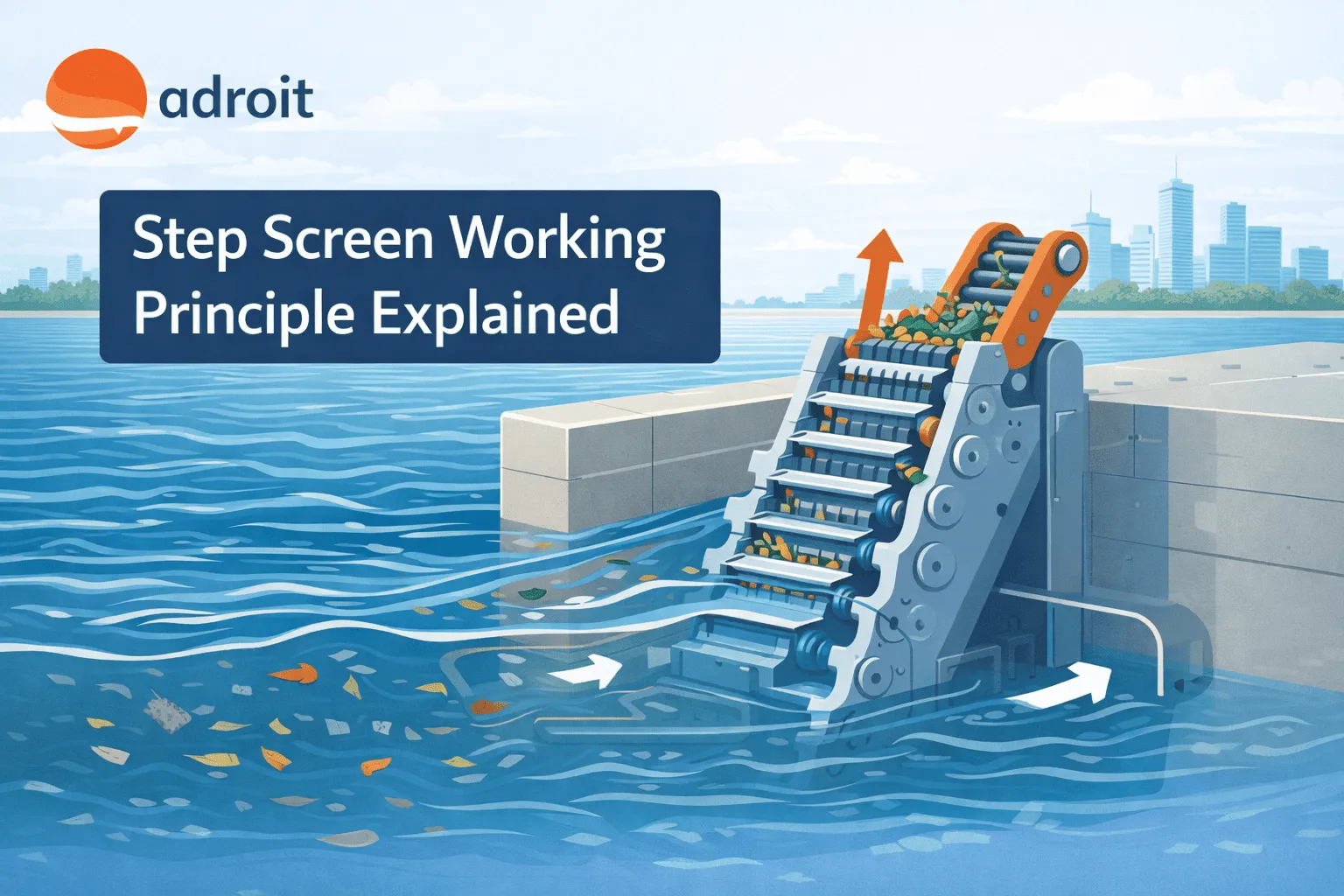

Screening is one of the most critical stages in wastewater treatment. The choice of screen can have a huge impact on plant efficiency, maintenance requirements and operational costs. Step screens, which are an effective and commonly used option for fine screening in sewage treatment plants, work on the principle of a ‘carpet effect‘, gradually lifting solids out of the flow. Step screens are known to provide dependable removal of debris and facilitate good hydraulic flow and a low headloss. Here, Adroid will explain about Step Screen Working Principle and how it achieves fine capture with low headloss.
What is a Step Screen?
A step screen is a mechanical device for screening fine solids from wastewater. A series of fixed and moving plates arranged in a stepped configuration allowing wastewater to pass through while capturing debris.
Compared to traditional bar screens, step screens rely on interlocking and mechanically operated lamella plates that perform a controlled step motion to gradually lift captured debris out of the wastewater channel.
Key Features
- Fine screening application
- Step like lamella plates
- Automatic debris lifting operation
- Minimal manual intervention.
Key Components of a Step Screen
Some of the key components of a step screen include the following:
- The Lamella Plates that are Fixed
These plates are the main surface that the liquids flow, as they are stationary plates that are fixed to form the surface which is. The plates are arranged in a vertical position and allow the liquid to flow through while trapping any solids.
- The Lamella Plates that are Moving
The plates will be lifted onto the step and removed from the plates by moving the upward plate.
- Mechanism for the Rendering of the Plates that are Movable
A motor mechanism is responsible for providing the upward lift of the plates along a fixed plane in a vertical position so that the plates will be positioned vertically.
- The Frame of the Trash or Wastewater.
This frame provides structural support and keeps the various other components aligned within the water.
- System of the Screen
A screen that is discharged, once it reaches the top of the water is discharged into a screening collection system or taken for disposal.
Step Screen Working Principle
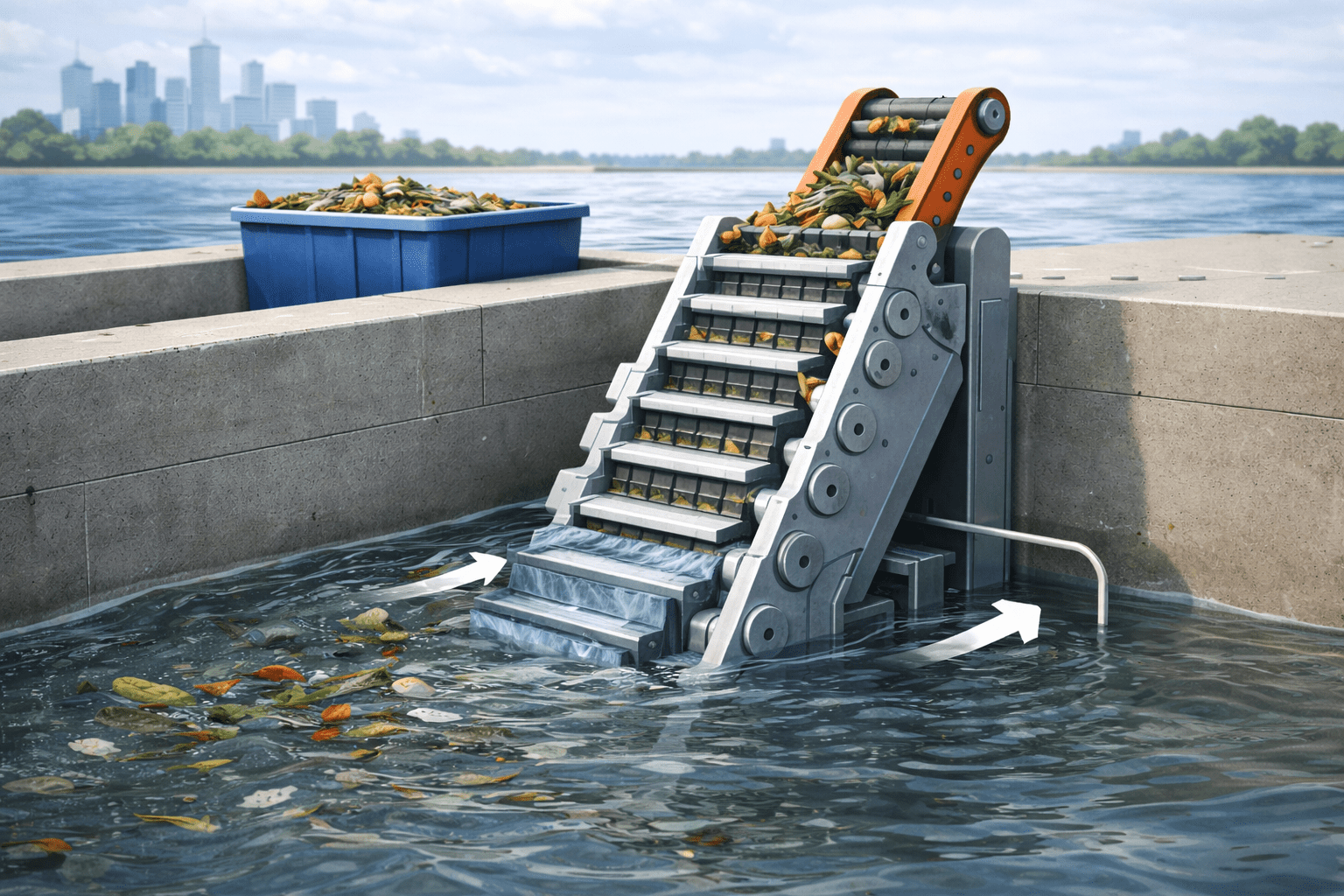
The method of operation of a screen is based upon a simple and effective concept, which is to use the effect of the carpet.
- The wastewater will enter the channel for screening, through a channel and flows over several panel plates for the cleaning of the channel.
- All of the solids within the flowing liquid come into contact with the panel plates and all solids are removed from the screen as a result of contact with the panel plates.
- Once the solids are removed from the channel through the use of a screen plate, the moving plate will raise the solids on top of the screen in a step like manner.
- Solids will be transferred upwards along the screen in a step like fashion.
- Once the solid particles/image reach the top of the screen, they will be discharged by means of a collection system.
What is the “Carpet Effect” in Step Screens?
In this mechanism, the solids that have been screened are deposited onto the screen surface to form a solid layer. The projection of the screen plate surface into the solids creates a lifting motion, similar to that of a carpet being pulled from underneath a group of people with debris on top of it.
Advantages of the Carpet Effect:
- Prevents debris from falling back into the channel.
- Provides continuous removal of screenings.
- Increases screening efficiency.
- Reduces clogs and blockages.
These characteristics make step screens particularly effective for separating long fibrous type materials, plastics and organic materials.
How Step Screens Achieve Fine Capture
Step screens capture very small particles and debris that could pass through a traditional bar-screened device.
The attributes that make fine captures possible are:
- Narrow slot openings that typically range from 2mm to 6mm.
- A large screening area which increases the chance of capturing the particles.
- A continuous cleaning action to eliminate any build up.
- The step lifting mechanism is designed to ensure that trapped materials are removed in a timely and efficient manner.
Why Step Screens Maintain Low Head Loss
Head loss is the decrease in pressure of water being pumped due to resistance through the screens and their associated equipment. Excessive amounts of head loss can lead to operational difficulties, such as flooding in the area above the step screen. Step screens have been engineered to maintain very low amounts of head loss, which is a key benefit to their use in a wastewater treatment facility.
Reasons for the low head loss include:
- An increased open flow area between the lamella plates
- Continuous removal of debris that has built up on the screen
- An angled screen which provides a better flow of water
- A highly effective cleaning process that will prevent any clogging
Key Design Parameters for Step Screens
Proper design and selection will maximize the performance of the step screen. Important design criteria can include;
- Size of Screen Opening
- A range between 2mm – 6mm.
- Determines how much of the fine solids are removed.
- Flow Rate – Must allow for both average and peak flow.
- Channel Dimensions – Width and depth of channel will impact the capacity of the step screen.
- Angle of Screen Inclination – Inclined position affects hydraulic performance and efficiency of removing debris.
- Material of Construction – Stainless Steel 304 and 316 are common materials used in the construction of screens due to their resistance to corrosion.
What are the Advantages of Step Screens?
- High efficiency with regard to fine screening.
- Result in very low head loss and stable hydraulic performance.
- Operate automatically and need little manual cleaning.
- Designed for energy efficiency.
- Dependable and have low maintenance.
- Remove fibre, plastics and other organics effectively.
Limitations of Step Screens
While step screens are quite efficient, they may not be the best option for all situations. Some possible limiting factors are:
- The step screen’s initial cost is usually higher than traditional manual screen installations.
- The amount of debris present in the wastewater may require that coarse pre-screening be done before passing through the step screen.
- They are not the best design choice when the wastewater has an extremely high “rag” content.
When Step Screens Are the Best Choice
Step screens are best suited for applications where fine screening and low head loss are required. Some common applications include:
- Municipal sewage treatment plants
- Industrial wastewater treatment plants
- Pump stations
- Food processing industries
- Textile and pharmaceutical wastewater treatment facilities
Step Screens vs Other Fine Screening Technologies
| Feature | Step Screen | Rotary Drum Screen | Fine Bar Screen |
| Working Principle | Step plates lift debris upward (carpet effect) | Rotating drum captures solids | Bars trap solids, removed by rake |
| Typical Slot Size | 2 to 6 mm | 0.5 to 6 mm | 3 to 10 mm |
| Headloss | Low | Medium | Medium to High |
| Clogging Risk | Low | Medium | Higher |
| Maintenance | Low | Medium | Medium |
| Best Use | Municipal STPs and fine screening | Industrial wastewater | Preliminary screening |
How Adroit Designs Efficient Step Screen Systems
- Custom-designed based on specific site requirements
- SS304 / SS316 material construction for corrosion resistance
- Low hydraulic head loss design
- Energy efficient drive systems
- Automation-ready step screen system designs
Frequently Asked Questions (FAQs)
What is the typical slot size used in step screens?
The typical slot size for step screens is within a range of 2 mm to 6 mm based on the desired level of fine screening and wastewater type being processed.
What types of solids can step screens remove?
Step screens are effective at removing solids like fibres, plastic, rags, paper, food and other solids suspended in water that could harm pumps or impact the treatment processes downstream.
Are step screens suitable for municipal sewage treatment plants?
Step screens are very commonly utilised in municipal waste treatment plants because they allow for efficient removal of fine debris from the effluent, while providing stable hydraulic performance with a minimal energy requirement.
How often do step screens require maintenance?
Routine inspection along with scheduled cleaning of the mechanical parts is typically all that is required for step screening devices, but due to their fully automatic function, manual assistance is seldom needed.