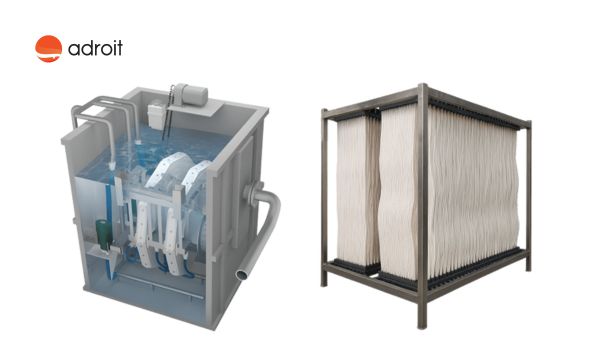


As water scarcity and environmental regulations become more pressing, advanced wastewater treatment becomes essential. Selecting the right filtration technology can significantly affect water quality, long-term sustainability, and operational efficiency in tertiary treatment. Some of the most reliable and prominent solutions include ultrafiltration (UF) and disk filters. Here, we are going to provide you with a proper guide on UF vs. Disk Filter: Which Technology Is Right for Your Tertiary Wastewater Treatment? Stay tuned to know more details!
Understanding Tertiary Wastewater Treatment
Tertiary wastewater treatment is the final stage in the wastewater treatment process. Unlike primary and secondary treatments, in which solids and organic matter are removed. To meet the stringent discharge or reuse standards, tertiary wastewater treatment focuses on eliminating the residual nutrients and pathogens.
Tertiary wastewater treatment is commonly used in industrial effluent systems, muncipal treatment plants, and water reuse applications such as groundwater recharge, irrigation, cooling systems, etc.
What Is UF (Ultrafiltration)?
Ultrafiltration (UF) is a treatment procedure that physically blocks contaminants as small as 0.01 microns by using semi-permeable membranes. These membranes create a physical barrier that only allows clean water and some dissolved salts to pass through. Some of the key advantages include the following:
- High Filtration Efficiency: Removes bacteria, viruses, and most suspended solids
- Consistent Effluent Quality: Suitable for high-purity reuse and regulatory compliance
- Compact Design: needs less space compared to conventional filters
Challenges:
- Higher Operational Cost: In this treatment, membranes require regular cleaning (CIP).
- Energy Usage: More energy is consumed for pumping water through membranes.
- Fouling Risk: If not properly managed, efficiency can be reduced due to membrane fouling.
UF is a wastewater treatment solution where water quality standards are strict, such as in pharmaceutical wastewater, industrial reuse, or water recycling in water-scarce regions.
What Is a Disk Filter?
Disk filters are mechanical filtration systems in which a stack of grooved plastic disks is used to trap particles during the filtration cycle. These systems typically remove particles in the range of 1 to 5 microns, and to clean the filter media, they rely on backwashing. Here are some of the key advantages of Disk Filters:
- Low Energy Consumption: Consumes minimal energy
- Simple Maintenance: Keeps filters clean by automatic backwashing
- Cost-Effective: Lower operational and capital costs as compared to the membrane system
Limitations:
- Limited Microbial Removal: This is not suitable for the filtration of viruses and fine particles
- Moderate Filtration Quality: Suitable for suspended solids but not for dissolved contaminants
This wastewater treatment is widely used in irrigation water treatment, municipal sewage treatment, and as pre-treatment systems before finer filtration like UF or RO.
Comparison: UF vs. Disk Filter
Here is the comparison between UF and Disk Filter
| Feature | Ultrafiltration (UF) | Disk Filter |
| Filtration Precision | 0.01–0.1 microns | 1–5 microns |
| Pathogen Removal | Excellent | Moderate |
| Turbidity Removal | High | Moderate |
| Energy Consumption | Medium to High | Low |
| System Complexity | High | Low |
| Maintenance | Frequent (CIP required) | Minimal (auto-backwash) |
| Operating Costs | Higher | Moderate |
| Ideal Applications | Water reuse, MBR, industry | Municipal, irrigation |
Key Factors to Consider Before Choosing
Selecting between UF and disk filters involves evaluating several key factors:
- Desired Effluent Quality: If you have an application that requires the removal of viruses and fine particles, then UF is the top choice for you.
- Budget Constraints: If you require a budget-friendly solution, then disk filters offer a lower-cost entry point with simpler operation.
- Available Space: For compact spaces, UF is a better choice.
- Operational Capacity: UF system requires regular maintenance and skilled operations.
- Influent Characteristics: High solid load may require pre-filtration or favor disk filters.
Recommended Use Cases
Use UF When:
- You need quality effluent for reuse or sensitive discharge points.
- Regulatory compliance is strict (e.g., food & beverage or pharma industries).
- You operate in water-scarce regions with a focus on sustainability.
Use Disk Filter When:
- Your goal is the cost-effective removal of suspended solids.
- The treated water will be used for irrigation or discharged to non-sensitive areas.
- You have limited skilled manpower or automation needs.
Adroit’s Expertise in Filtration Technologies
With extensive experience and expertise in wastewater treatment, Adroit provides both UF and disk filter systems, designed specifically for reliability, scalability, and compliance with global quality standards. Our solutions include:
- UF Skid Systems for industrial and commercial water reuse
- Disk Filter Units for municipal and agricultural applications
- Customized Engineering based on client-specific influent and effluent parameters
- After-sales service, maintenance training, and AMC support
Contact Us Today!
Address: 01/101 Satguru Prime -11, Scheme – 140 Main Road, opposite Vaishnav Dham Mandir, Indore, Madhya Pradesh 452016
Email: [email protected]
Phone No: +91 70248-48383
Frequently Asked Questions About UF vs. Disk Filter: Which Technology Is Right for Your Tertiary Wastewater Treatment?
Question 1. What is the primary difference between UF and disk filter technologies?
Answer. The primary difference between UF and disk filter technologies is that ultrafiltration (UF) uses membrane technology to physically remove bacteria, fine particles, and viruses at the microscopic level. Whereas disk filters use mechanical filtration with rotating disks to trap suspended solids above a certain micron size.
Question 2. Which filtration method offers better water quality—UF or Disk Filter?
Answer. UF provides higher water quality due to its ability to remove smaller particles, such as microorganisms, viruses, etc. However, Disk Filters are only suitable for applications where only suspended solids need to be removed.
Question 3. How do maintenance requirements compare between UF and Disk Filters?
Answer. Disk filters generally require less maintenance and are easier to clean mechanically. However, UF systems need regular cleaning to prevent fouling and membrane degradation.
Question 4. Which system is more suitable for water reuse applications?
Answer. Due to its superior pathogen and turbidity removal capabilities, UF is often preferred for water reuse applications, making it ideal for high-quality effluent production.