
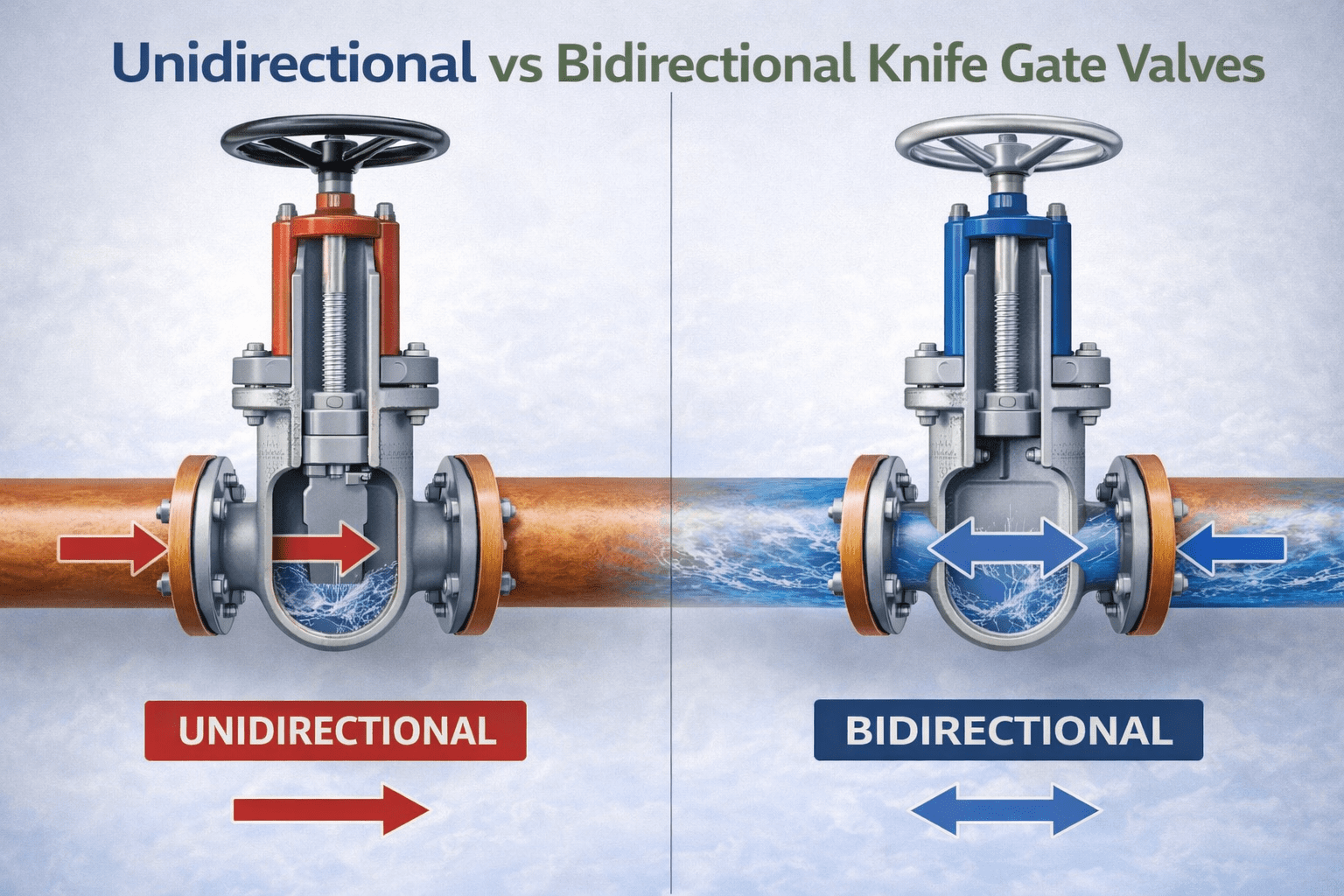

In sludge, slurry, and wastewater settings, isolation failure is more than just an inconvenience. A faulty or improperly selected valve could also result in unplanned shutdowns, increased maintenance, potential environmental hazards, and high operating expenses. If the slurry or sludge continues to pass through a pipe that is designed to be isolated, it can also accelerate the wear on pumps, pipes, and downstream equipment.
This is why choosing the appropriate knife gate valve is critical. Not all knife gate valves are suitable for handling media with high solid contents or reverse pressure conditions. When choosing between a unidirectional and a bidirectional design, you will determine whether your facility runs smoothly or experiences ongoing equipment breakdowns.
Adroit Water Technologies is a well-respected manufacturer and supplier of industrial wastewater isolation valves. We provide engineered solutions for demanding sludge or slurry applications. This guide provides information on the difference between unidirectional knife gate valves and bidirectional knife gate valves, their ideal applications, and how to choose the best knife gate valve for your facility.
What is a Knife Gate Valve?
A knife gate valve is a linear-motion isolation valve designed primarily for complete on/off of flow in slurry, sludge, pulp, wastewater, and other solids-laden fluids. Pressure capability depends on valve design and standards compliance (e.g., AWWA C520). Knife gate valves are designed for low-pressure systems handling slurry and wastewater.
Unlike conventional gate and globe valves, slurry valves utilize a thin, beveled gate that is designed to cut through solids. This unique feature helps to avoid clogs and provides dependable shut-off capabilities regardless of whether or not the media has suspended particles or fibrous materials present.
The primary differences between a wastewater isolation valve of this type and other industrial isolation valves are that wastewater isolation valves were designed with the intent to provide good, tight shut-off features in very rough service environments, as opposed to providing throttling or precise flow control. Typical applications for knife gate valves include:
- The presence of high solids content in the media
- Abrasion identification
- High viscosity sludge applications
- Municipal or Industrial Wastewater Applications
Due to their simple design characteristics, small cavity volume, and effective sealing ability, knife gate valves are well-suited for difficult isolation applications.
What is a Unidirectional Knife Gate Valve?
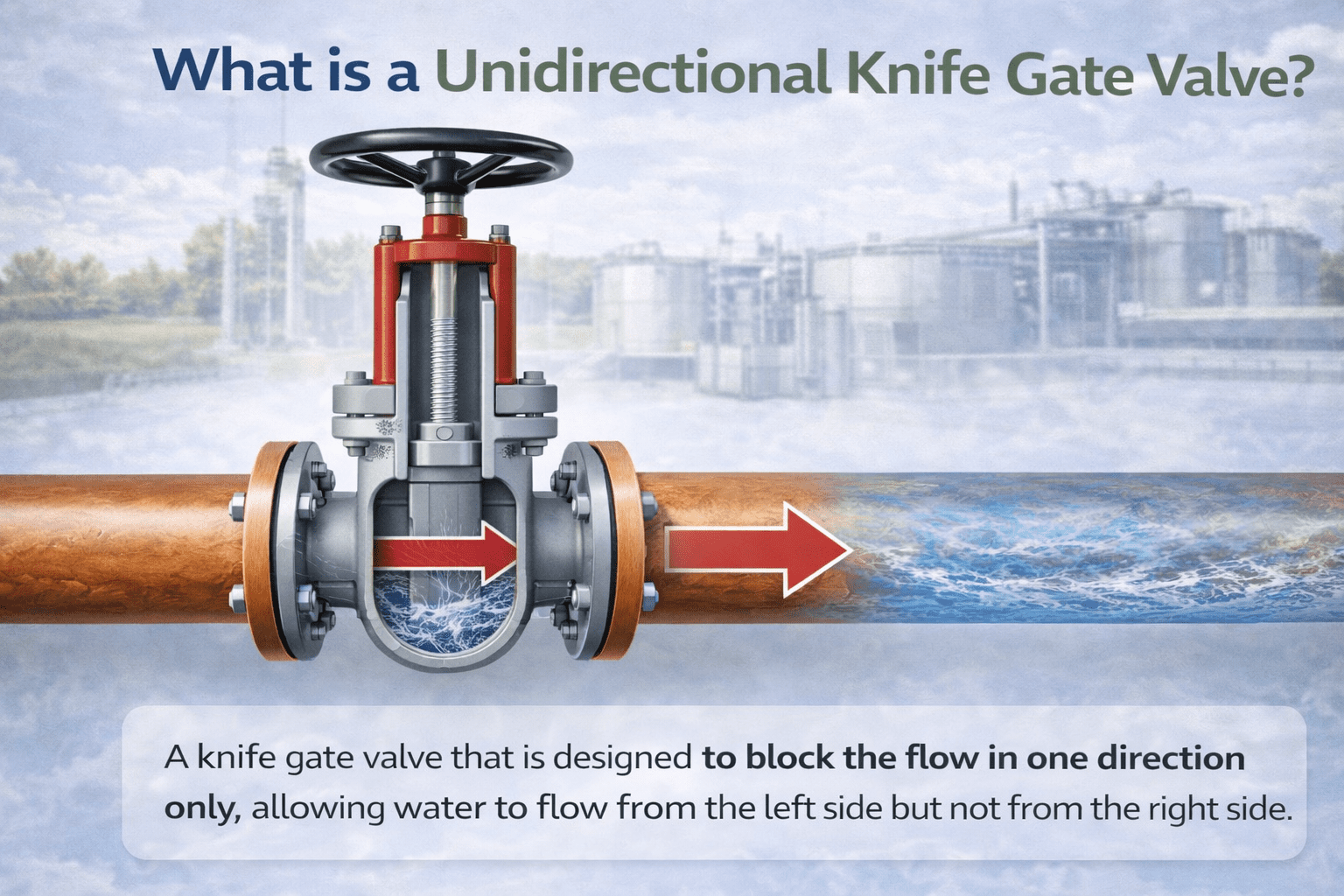
Unidirectional knife gate valves are also referred to as ‘single direction’ valves and are designed to provide an effective seal against pressure flowing in one direction only.
Design & Working Principle
A unidirectional knife gate has a single (or ISO) seat located on one side of the valve body. The gate moves downward and, when closed, seals against the single (or ISO) seat. Additionally, as pressure enters through the designated flow direction, the pressure inside the valve assists in the sealing process by pushing the gate down onto the ISO seat.
Due to being designed to operate only in one direction when installed, the installation direction of these valves is extremely important. If the valves are installed incorrectly, the ability of the valve to perform sealing will be affected. These valves have been designed to perform optimally in moderate-pressure applications and will not be able to function properly should the direction of flow be reversed.
Benefits
Unidirectional knife gate valves are a very economical option for many different types of wastewater and sludge systems, given that they are small enough to fit into tight pipe configurations. These valves are ideally suited for low and medium-pressure sludge lines that have controlled and consistent flow direction.
Drawbacks
Unidirectional knife gate valves do not have the ability to accommodate reverse pressure. In addition, should reverse flow occur, the valve will leak as they do not have a secondary seat to seal against the reverse pressure. Therefore, they are not recommended for use in slurry return systems or other applications where there will be a requirement for bidirectional sealing.
Best Uses
Unidirectional knife gate valves are well-suited for:
- ETP and STP pipelines
- Gravity flow wastewater systems
- Isolating tank outlets
- Sludge discharge lines
These systems have been designed with a predictable flow direction; therefore, the reverse pressure will not be encountered.
What is a Bidirectional Knife Gate Valve?
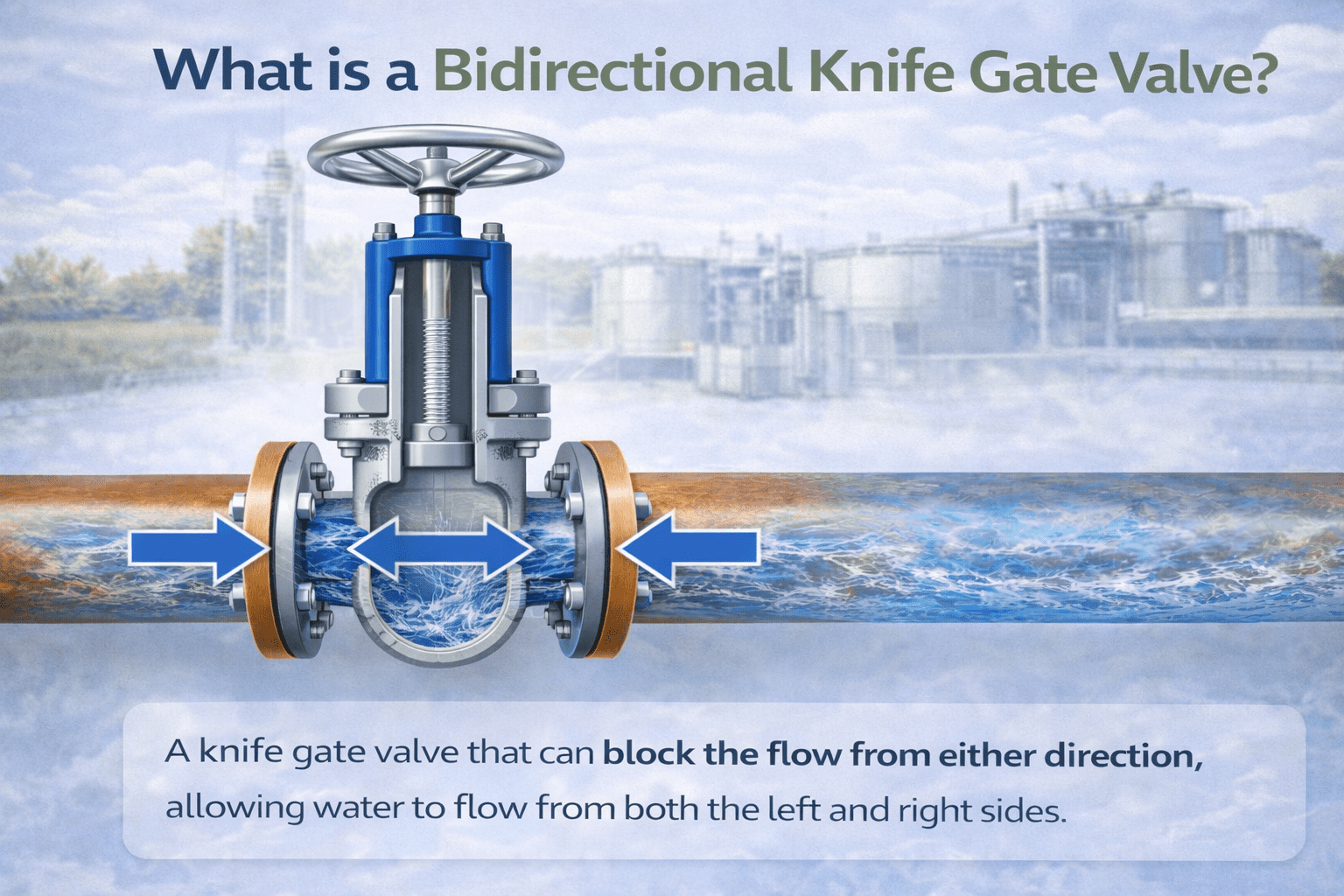
A bidirectional knife gate valve provides a sealing surface in both flow directions and is considered both a heavy-duty slurry valve and a slurry isolation valve.
Design & Working Mechanism
The dual-seated knife gate design consists of resilient or metal seats positioned on opposite sides of the knife gate. When the knife gate closes against one of these seats, it creates a seal against that seat, depending on the direction in which the valve is subjected to pressure (usually upstream).
The effective sealing of the bidirectional knife gate valve provides for the handling of reverse pressure with no degradation of performance. The structure is also more robust than that of conventional knife gates because it’s engineered to allow for more precise sealing at higher pressures, and it provides enhanced resistance to wear and tear from materials such as sand and dirt, etc.
Benefits:
The ability to efficiently handle reverse pressure makes the bidirectional knife gate valve well-suited for use in complex piping systems. The reinforced structures of these valves allow for higher pressure handling capabilities and better resistance to the abrasive nature of slurries that may contain solids and undergo pressure variations.
Drawbacks:
The bidirectional knife gate valve is more expensive than the conventional knife gate design due to its weight and the additional mechanical components needed to create its two-seat design, which may also require extra space when installing the valve in comparison to a compact unidirectional knife gate design.
Typical Uses for Bidirectional Knife Gate Valves:
Bidirectional knife gate valves are commonly used in:
- Slurry transfer
- Pump discharges
- Mining slurries
- Industrial wastewater treatment
These types of applications frequently encounter pressure fluctuations and abrasive media; therefore, it is essential to have bidirectional sealing capability.
Unidirectional vs. Bidirectional Knife Gate Valves – A Side-by-Side Comparison
When selecting a knife gate valve for isolation of sludge or wastewater, knowing how the construction and performance differ from one another is very important. The following is a comparison.
| Feature | Unidirectional Knife Gate Valve | Bidirectional Knife Gate Valve |
| Flow Direction | One-way | Two-way |
| Pressure Handling | Moderate | High |
| Cost | Lower | Higher |
| Slurry Suitability | Medium | Heavy slurry |
| Reverse Pressure | Not suitable | Suitable |
| Maintenance | Easier | Moderate |
This side by side comparison facilitates the knife gate selection guide in understanding quickly how to choose the right knife gate valve when you have to select a knife gate valve for applications involving sludge, slurry, and wastewater with severe service applications.
How to Select the Most Appropriate Knife Gate Valve to Handle Sludge, Slurry, and Wastewater
The selection of the appropriate slurry isolation valve requires consideration of multiple operational criteria:
- Type of Media
Are you handling heavy sludge or a highly abrasive slurry? If your sludge contains a relatively low concentration of solids, a unidirectional valve may suffice. Whereas, if you are pumping an abrasive slurry containing a significant concentration of solids, then reinforced seal designs and stronger valve materials are required, which typically leads to selecting a bidirectional valve.
- Flow Direction Requirements
Can reverse pressure occur in your application? Back pressure within pump discharge lines, connected piping systems can create reverse flow pressure within your system, so if reverse flow is even a remote possibility, then a bidirectional knife gate valve is the wisest selection. It is critical to evaluate the hydraulic and overall design of your system before making a decision.
- Pressure Ratings and Temperature Ratings
Verify that the pressure class of the Valves meets or exceeds your maximum working pressure in your system. Temperature ratings are also important, as process conditions can vary greatly from application to application in an industrial wastewater conveying system.
- Actuation Requirements
Manually operated knife gate valves are good for smaller diameter lines; pneumatic actuated knife gate valves are suitable for most automated wastewater treatment facilities; but generally, electric actuators are used for both remote and precise control (and the appropriate actuator should meet both your system’s automation requirements).
- Maintenance and Lifecycle Costs
Initial price should not be the only consideration; take into account the following: wear rates, availability of spare parts, likelihood of experiencing downtime due to equipment failure, and total lifecycle cost. An expensive, heavy-duty slurry valve will have much lower long-term maintenance costs compared to a cheap, light-duty slurry valve.
Some things to watch for when shopping for knife gate valves.
There are many operational issues that occur due to improper selection of knife gate valves, not because of product failure.
- A common mistake when selecting a knife gate valve is to use a unidirectional (flow through one direction only) knife gate valve in a system with reverse pressure applied to the valve. This will result in leaks and repeated maintenance of the valve.
- Failing to consider the abrasiveness of a slurry will significantly shorten the lifespan of the knife gate valve. Slurries that are abrasive require hardened materials and reinforced sealing systems to ensure long tube life.
- Failure to consider actuator compatibility may lead to trouble installing or automating the valve.
- In high-solid waste systems, underestimating how often you will need to maintain your knife gate valve will lead to increased repair costs and unplanned downtime.
Using a knife gate valve selection guide can help you avoid making costly mistakes.
Why Choose Adroit Water Technologies for Knife Gate Valves?
Adroit Water Technologies manufactures knife gate valves specifically for use within wastewater systems and sludge/slurries as an isolation valve provider that offers expertise in handling high solids content and abrasives. Each valve is made to withstand the rigors of the industrial environment so that it will work and not fail.
- Custom-engineered solutions for isolating facilities allow for determining the correct material, seal configuration, and pressure rating requirements.
- Valves manufactured with heavy-duty construction and high reliability in sealing will reduce lockout time on the system and increase the system’s life.
- Complete technical support after the sale will assist customers with installation, actuator integration, and maintenance planning.
All valves manufactured by Adroit Water Technologies are built to all appropriate industry standards for performance and safety.
For those looking for a reliable slurry isolation valve solution, consulting Adroit Water Technologies will lead to sound technical and application-based solutions.
Frequently Asked Questions:
Q1: What is the difference between unidirectional and bidirectional knife gate valves?
Ans. A unidirectional knife gate valve will seal in one flow direction, while a bidirectional knife gate valve seals a flow in both directions. Bidirectional will hold back the pressure of flowing back through the valve, in addition, thus allowing use on complex slurry systems.
Q2: What is the better knife gate valve for use on slurries?
Ans. If the slurry is light and flows consistently, a unidirectional might work just fine; however, if the slurry is heavy and an abrasive product or pressures fluctuate during operation, a bidirectional knife gate valve is generally more suitable.
Q3: Are unidirectional knife gate valves suitable for use under reverse pressure?
Ans. Unidirectional Knife Gate valves cannot accommodate reverse pressure. If subjected to reverse pressure, the seal may not function as designed, leading to possible leakage and loss of performance.
Q4: Are knife gate valves an appropriate valve for sewage treatment facilities?
Ans. Yes, knife gate valves can be successfully used in sewage treatment facilities and are an ideal method of isolating sludge lines/slurry pipelines or any media that has a high percentage of solids.
Q5: How do you choose the proper isolation valve for slurries?
Ans. To properly select an isolation valve for slurries, you need to consider the type of material you will be isolating, the quantity of solids in the slurry, the pressure rating of the isolation valve, and the direction of flow and actuation required. Reviewing all the factors above will assist in making the correct selection of a unidirectional versus a bidirectional knife gate valve.
Conclusion!
When determining whether to use a unidirectional or bidirectional knife gate valve, you need to consider the characteristics of the slurry you are isolating, the pressure conditions under which the valve will be operating, and the configuration of your system. Unidirectional knife gate valves are designed to be a more cost-effective method of isolating a flow that occurs only in one direction. Bidirectional knife gate valves, on the other hand, are better suited for demanding applications, such as those found in slurry and wastewater systems, where reverse pressure is a concern.
Using a methodical process to make your decision—by considering the type of material you will be isolating, the direction of flow, the pressure rating of the valve, the required actuation method, and the lifecycle cost of the valve—will ensure that you get reliable performance and fewer episodes of downtime.
Selecting the right valve is not only about paying for the valve up front. It is also about maximizing your long-term operational efficiency and reliability.
Contact Adroit Water Technologies for expert assistance in selecting the right knife gate valve for your sludge, slurry, and wastewater isolation needs.