
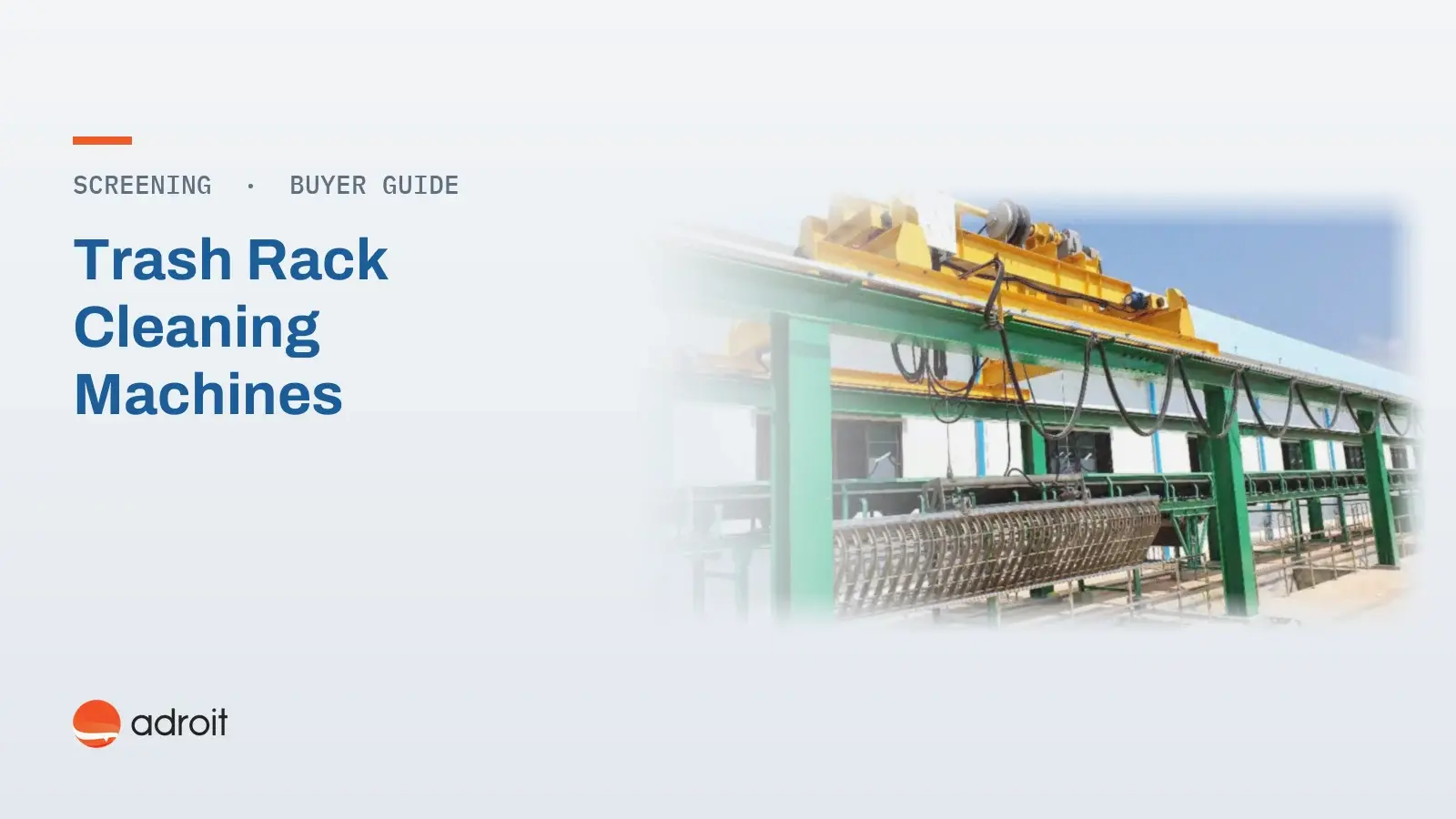

A trash rack cleaning machine is a mechanical rake or grab that removes debris from the coarse bar rack in front of a pumping station, so the rack does not block and the pumps keep their design flow. The main types are continuous chain-driven multi-rake screens, intermittent grab cleaners, and single-rake machines on ropes, hydraulic arms or climbing drives. The right choice depends on the debris, the width and depth of the channel, the number of bays and how fast debris arrives. This guide compares the types and sets out the checks that decide between them.
What a trash rack does at a pumping station
A trash rack is a coarse bar screen across the approach channel or sump inlet. It stops logs, branches, vegetation, plastics and rags before they reach the pump impellers. The clear opening between bars is set by what the pumps can pass:
- The US Army Corps of Engineers manual for pumping station design (EM 1110-2-3102) recommends a clear opening of about 45 mm, never more than 75 mm, coordinated with the pump manufacturer. It also limits the velocity through the gross rack area to 0.76 m/s (2.5 ft/s).
- The Hong Kong Drainage Services Department’s Sewerage Manual says the screen aperture should be compatible with the solids-passing capability of the downstream pumps, and that mechanical screens are preferred to manual rake or basket screens wherever practicable.
A rack only works if it is kept clean. The Hydraulic Institute’s pump intake standard (ANSI/HI 9.8) warns that partially clogged trash racks can create severely skewed flow patterns at the pumps. As a rack blinds, head loss rises and the water level on the pump side falls, which reduces pump submergence and capacity. The cleaning machine exists to stop that happening.
Why the rack needs mechanical cleaning
Hand raking is acceptable only for small racks that collect little debris. EM 1110-2-3102 states that operating staff should never have to hand-rake debris from a sanitary or combined sewer. It calls for mechanical raking wherever the sump is deep, the debris load is significant or the debris is too heavy to lift by hand. Deep wet wells, wide river intakes and storm water stations meet all three conditions.
Mechanical cleaning also lets the rack be cleaned while the pumps run, at night and during storms, when debris loads are highest and nobody should be standing over an open channel.
Types of trash rack cleaning machine
The US Bureau of Reclamation’s design standard on trashracks (DS-6, Chapter 12) lists the common mechanical cleaners: hydraulic trash rakes, overhead monorail rakes with a hoist and gripper claw, backhoe-type rakes, and cleaners built over each rack bay. In pumping stations they fall into three groups.
Chain-driven multi-rake screens (continuous cleaning)
Several rakes are fixed to endless chains on both sides of the rack. They travel up the bar face one after another, comb out the debris and drop it into a chute at the top. Cleaning is continuous or frequent, so the rack never builds up a heavy mat.
- The Rakeflow® multi-rake bar screen suits sewage pumping stations and treatment plant inlets. It is built for channels 400–3,000 mm wide and up to 20 m deep, with bar spacing from 3 mm to 100 mm. There are no bearings or sprockets at the bottom of the channel.
- The automatic rotary trash bar screen is the heavy version for river intakes and storm water stations. Single screens are 2–8 m wide and 5–13 m high, with a bar rack inclined at 75° and a typical bar opening of 50 mm. Four to five rakes on double chains each lift 300–500 kg of trash per cycle.
Grab cleaners (intermittent cleaning)
A grab bucket hangs from a hoist or travelling trolley above the rack. It is lowered along the bars to the channel floor, closes on the debris and lifts it out, then travels to a chute, conveyor or skip to discharge. Because it works in cycles, a grab can deal with sudden heavy loads without running all day. On a travelling trolley, one grab can serve several bays across a wide intake. A grab is the usual answer for logs, large branches and bulky items that would jam a rake.

Single-rake machines
A single rake is moved up the rack by wire ropes, a hydraulic arm, or a drive that climbs a toothed rack. Rope and climbing machines have no moving parts under water. Hydraulic-arm rakes can be mounted on rails to serve several bays and can reach over obstructions. Cleaning is intermittent, and capacity per stroke is set by the rake size.
| Type | Cleaning | Best suited to | Watch points |
|---|---|---|---|
| Chain multi-rake | Continuous or frequent | Sewage pumping stations and inlet works with steady loads of rags and plastics | Chain wear; channel width limits for a single unit |
| Rotary trash bar screen | Continuous | Wide, deep river and storm water channels with heavy floating trash | Needs a matched conveyor and hopper for the screenings |
| Grab cleaner | Intermittent | Logs, branches and bulky debris; several bays served by one grab | Cycle time limits capacity during sustained heavy loads |
| Single rake (rope, hydraulic arm, climbing) | Intermittent | Moderate loads; retrofits to existing racks | Capacity per stroke; reach on deep racks |
How to choose a trash rack cleaning machine
Debris type and peak load
Start with what arrives and how fast. Rags, wipes and plastics in sewage arrive steadily and suit continuous chain screens. Logs and timber need a grab or a heavy-duty rake. Vegetation and floating trash at river and drainage intakes arrive in pulses after rain, so size the machine for the peak load, not the average day.
Channel width, depth and number of bays
Narrow sewage channels suit one multi-rake screen per channel. Wide intakes may need several screens side by side, or a single grab or rail-mounted rake that travels between bays. Deep channels favour machines with no submerged mechanical parts, so routine maintenance does not require draining the channel.
Bar spacing and velocity
Set the clear opening from the pump’s solids passage and the guidance above, then check the velocity. The Bureau of Reclamation sizes trashracks for an approach velocity of about 0.3–0.6 m/s (1–2 ft/s) at normal flow, and EM 1110-2-3102 caps velocity through the gross rack area at 0.76 m/s. Narrower spacing catches more but blinds faster, so it raises both head loss and the cleaning duty. Our guide to bar screen spacing covers the trade-off in more detail.
Rack angle
The Bureau of Reclamation notes that mechanically raked racks are typically inclined 5–30° from vertical, although some rakes and most grabs can also clean vertical racks. An inclined rack helps the rake hold its load on the way up. Confirm the angle with the machine supplier before the civil design is frozen.
Controls and rack design
Mechanical cleaners are usually started by a timer, by a level-difference signal across the rack, or both. The Bureau of Reclamation allows racks with automatic cleaning or differential-level alarms to be designed for a lower differential head (typically 1.5 m, or 5 ft) than unattended racks, which must withstand much higher loads if they become fully blocked.
Screenings handling
The cleaner is only half the system. EM 1110-2-3102 asks for storage space for removed trash and truck access to it. Plan the chute, belt or screw conveyor, hopper or skip, and the disposal route at the same time as the machine.
Materials
Wetted parts in sewage should be stainless steel, because septic sewage releases hydrogen sulphide that attacks carbon steel and concrete; the US EPA has documented this corrosion in collection systems. For raw water and storm water, coated carbon steel can be acceptable where the specification allows it.
Regional conditions that change the choice
- Southeast Asia: monsoon flows carry water hyacinth and floating trash to river intakes and flood pumping stations. Water hyacinth can double its population in as little as 6–18 days in warm water (University of Florida IFAS), so mats build quickly and arrive in large volumes. Continuous rotary screens or high-capacity grabs are the usual answer.
- Gulf states: long sewer runs and high temperatures produce septic, hydrogen-sulphide-rich sewage at pumping stations, which makes stainless steel construction and enclosed screenings handling more important.
Information needed for a quotation
- Number of channels or bays, their width and depth, and the water levels.
- Peak flow and the pumps’ solids-passing size.
- Debris type and expected quantity, including storm peaks.
- Existing or proposed rack spacing and angle.
- Discharge height and how screenings will be conveyed and removed.
- Operating mode (manual, timer, level difference) and power supply.
Frequently asked questions
What is the difference between a trash rack and a bar screen?
A trash rack is a very coarse bar screen that protects pumps and intakes from bulky debris, with openings set by the pumps (EM 1110-2-3102 suggests about 45 mm and no more than 75 mm at flood pumping stations). Finer bar screens at treatment plant inlets protect the treatment process.
When should I choose a grab cleaner instead of a raking screen?
Choose a grab where debris is large or heavy, such as logs and branches, or where one machine must serve several bays. Choose a chain multi-rake or rotary screen where debris arrives continuously and the rack must never build up a mat.
Can a cleaning machine be fitted to an existing trash rack?
Often, yes. Grab cleaners and single-rake machines are commonly retrofitted, but the rack must be straight and aligned, with cross-members recessed behind the bar face so they do not catch the rake or grab (the Bureau of Reclamation suggests at least 38 mm).
How is the cleaning cycle started?
Usually by a timer, by a level-difference signal across the rack, or by both. Many stations also allow manual starts during storms.
Adroit supplies the automatic grab screen for manual, semi-automatic or fully automatic operation, alongside its multi-rake and rotary trash bar screens. Send your channel dimensions, flows and debris details through our contact page for a recommendation.