
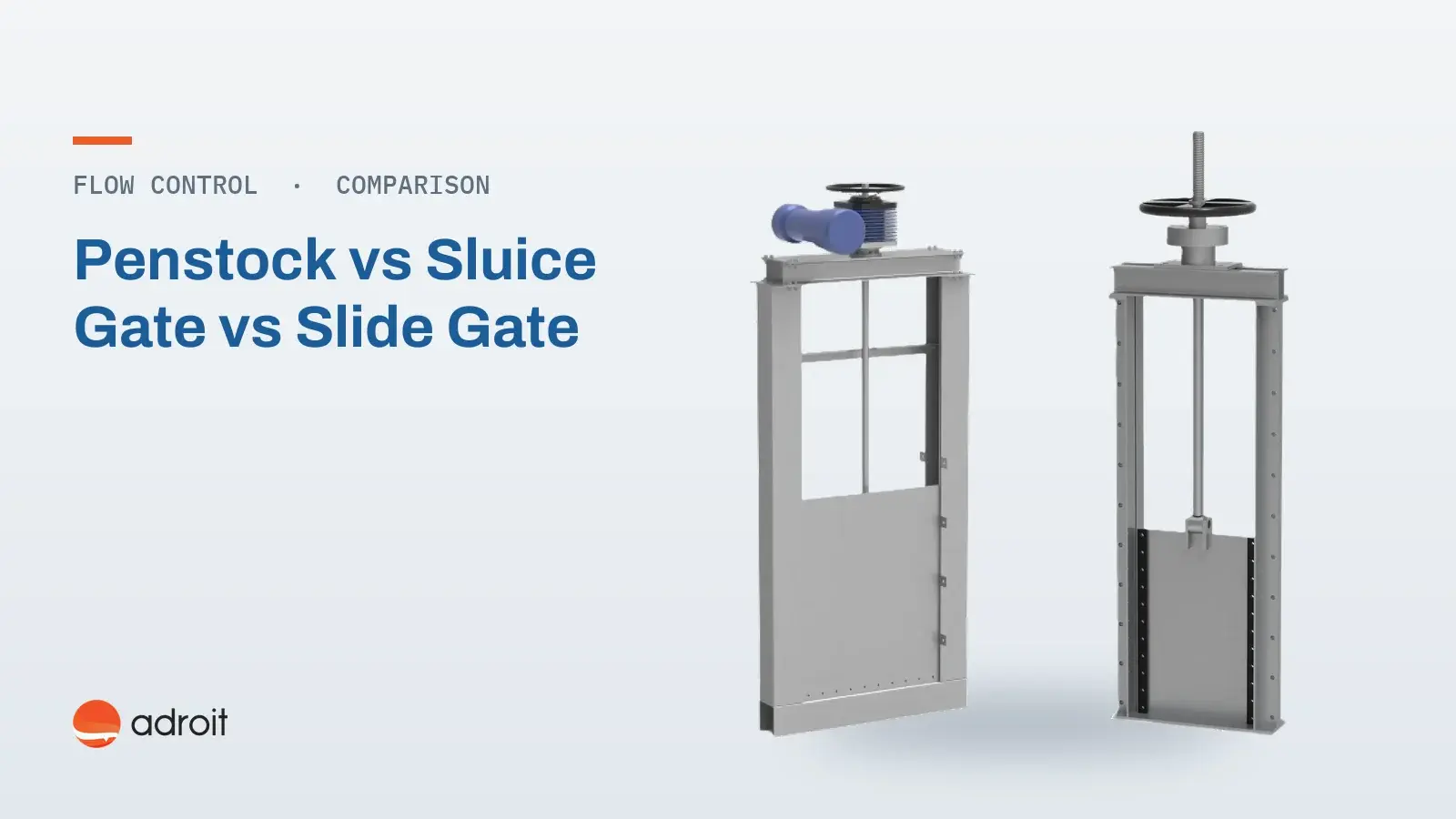

Penstock, sluice gate and slide gate are three names for the same device: a flat gate that slides in guides over a wall opening or across a channel to isolate or control flow. British-style specifications, used in the UK, the Middle East, Hong Kong, Singapore and Malaysia, call it a penstock. US specifications and the AWWA standards call it a slide gate, and tenders in South Asia usually say sluice gate. The name mostly tells you which standard and vocabulary the specification follows, not a different piece of equipment. This guide maps the terms, the standards and the gate types, and shows how to write an enquiry that any manufacturer will read correctly.
One device, three names
Every version has the same parts: a frame fixed to the wall or channel, guides, a moving leaf, seals, a threaded stem and an operator. What changes from region to region is the word on the drawing and the standard in the specification.
| Region | Usual term | Typical reference |
|---|---|---|
| United Kingdom and Ireland | Penstock | BS 7775 |
| Middle East (Gulf states) | Penstock | BS 7775 or AWWA, depending on the consultant |
| Hong Kong | Penstock | Consultant specification; the Drainage Services Department’s Sewerage Manual refers to penstocks and stoplogs at pumping stations |
| Singapore and Malaysia | Penstock | Consultant specification; the Malaysian Sewerage Industry Guidelines refer to penstocks at treatment plant inlets |
| United States | Slide gate | AWWA C560, C561, C562 or C563 |
| South Asia | Sluice gate | AWWA C561, BS 7775 or a national standard named in the tender |
Why the US says slide gate
The US once said sluice gate too. AWWA’s first standard for these gates, approved in 1941, covered cast-iron sluice gates. AWWA’s Standards Council later directed that “slide gate” be used instead of “sluice gate”, and the old standard C501 was redesignated C560. The stainless steel, aluminium and composite standards that followed were numbered C561 to C563. Older US drawings and some city specifications still use “sluice gate”.
Same word, different equipment
Each name is also used for something else, and these meanings cause most of the mix-ups in tenders:
- Penstock in hydropower is a closed pipe that carries water from the intake to the turbines (the US Bureau of Reclamation defines it this way). It is not a gate.
- Sluice valve is the British and South Asian name for a gate valve inside a pressure pipeline, not a wall-mounted gate. See sluice valve vs gate valve.
- Slide gate in bulk handling is a gate at the outlet of a hopper or silo that controls the flow of powders and granules.
The vocabulary side by side
British and American documents also name the parts and loads differently. The terms below mean the same thing.
| British (penstock) usage | US (slide gate) usage | Meaning |
|---|---|---|
| Door | Slide | The moving leaf that closes the opening |
| Spindle | Stem | The threaded rod that raises and lowers the leaf |
| Headstock | Operator, floorstand or yoke | The lifting mechanism and its support above the gate |
| On-seating head | Seating head | Water pressure pushing the leaf onto its seals |
| Off-seating head | Unseating head | Water pressure pushing the leaf away from its seals |
| Rising or non-rising spindle | Rising or non-rising stem | Whether the threaded rod moves up with the leaf |
The standards behind each name
| Standard | Scope | Notes |
|---|---|---|
| AWWA C560 | Cast-iron slide gates | Cast iron or ductile iron slide and frame, machined metal seating faces and wedges |
| AWWA C561 | Fabricated stainless steel slide gates | Fabricated slide with UHMW-PE seating faces and resilient seals |
| AWWA C562 | Fabricated aluminium slide gates | Light and corrosion-resistant for many channel duties |
| AWWA C563 | Fabricated composite slide gates | Fibreglass-reinforced composite or plastic slide with resilient seals |
| AWWA C513 | Open-channel fabricated metal slide gates and weir gates | Listed as withdrawn by AWWA, but still cited in older specifications |
| BS 7775:2005 | Penstocks for use in water and other liquid flow applications | Design, performance, testing and installation requirements for penstocks |
The AWWA and British standards set their own design loads, leakage limits and test methods. Specifications based on AWWA C561, for example, commonly limit leakage to 0.1 US gpm per foot of seating perimeter under seating head, about 1.24 L/min per metre. BS 7775 sets its own leakage rates and on-site test. A gate tested to one standard has not automatically been tested to the other, so a specification should name one design standard and state the heads in its terms. For what each standard means in practice, see AWWA C561 and BS 7775 for buyers.
Types of penstock and sluice gate
Whatever the name, gates are grouped by how they are mounted and which way they open.
Wall-mounted (face-wall) gates
The frame is bolted to the face of a wall over an opening or pipe, and the leaf seals on all four sides. These gates hold back water under head at tank outlets, pump sumps, wet wells and inlet chambers. Because they seal on four sides, they are leakage-tested to the design standard.
Channel gates
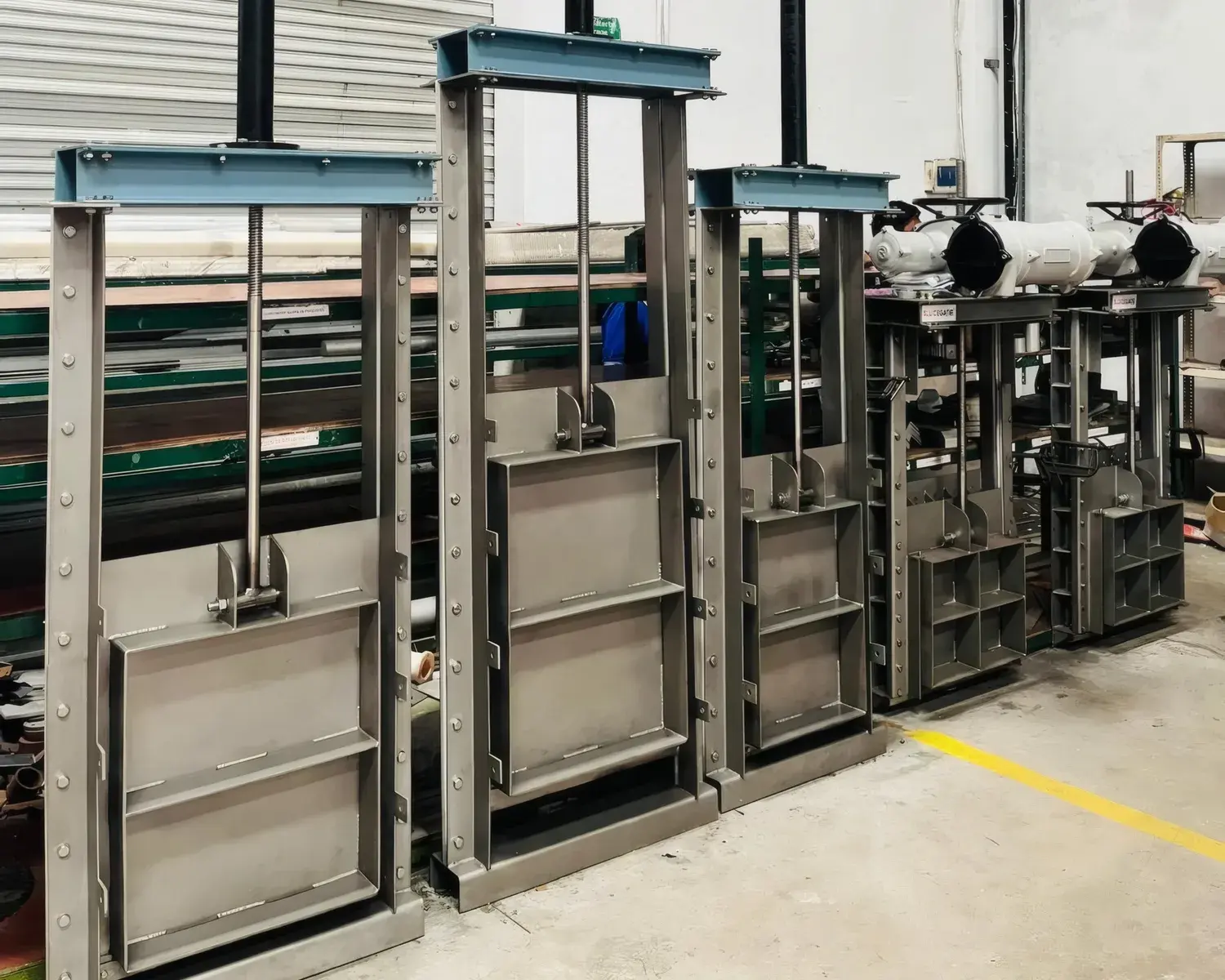
The frame sits between two parallel channel walls, anchored to or embedded in the side walls, and the leaf seals on three sides: both sides and the bottom. They isolate open channels where the water stays below the top of the closed gate. Because there is no top seal, a leakage test does not apply.
Weir (downward-opening) gates
A weir penstock opens by lowering the leaf, so water spills over its top edge instead of passing beneath it. It sets or adjusts a water level and is used for decanting, flow splitting and level control. AWWA C513 covered downward-opening weir gates alongside upward-opening channel gates.
Flap gates are a different device
A flap gate is hinged along its top edge. It opens under outflow and closes when the water level downstream rises above the level upstream, so it works as a non-return device at outfalls and drain outlets. It has no stem or operator and does not isolate flow on demand, so it is not a penstock and is not covered by the slide gate standards. Stop logs, which are beams dropped into grooves for a temporary closure, are also a separate item.
How to write an enquiry any manufacturer reads correctly
Using both names once, such as “penstock (sluice gate / slide gate)”, removes any doubt for a supplier working in another vocabulary. Then state:
- Gate type: wall-mounted, channel or weir, and the number of sides sealed.
- Clear opening width and height.
- Seating and unseating head (on-seating and off-seating head) in metres of water, with the reference level used, such as the gate centreline.
- Design standard: BS 7775 or the relevant AWWA standard.
- Material: stainless steel grade, aluminium, coated mild steel or super duplex.
- Stem or spindle type, frame type (self-contained or open top) and the distance from the gate to the operating floor.
- Operation: handwheel, gearbox or electric actuator.
Frequently asked questions
Is a penstock the same as a sluice gate?
Yes, in water and wastewater work. Both describe a sliding gate that closes an opening in a wall or channel; the name depends on the region, the consultant and the design standard.
Is a penstock gate the same as a hydropower penstock?
No. In hydropower, a penstock is the pressure pipe that carries water to the turbines. A penstock gate is a sliding gate on a wall or channel.
Should I specify BS 7775 or AWWA C561?
Follow the standard the project specification uses, which usually reflects the consultant’s background. Name one standard rather than both, because each has its own loads, leakage limits and tests.
Is a flap gate a type of penstock?
No. A flap gate is a hinged non-return gate that opens and closes with the water level. A penstock is raised and lowered by a stem to isolate or control flow.
Adroit designs and manufactures fabricated sluice gates and penstocks to AWWA C561, AWWA C562 and BS 7775, in face-wall and open-channel versions, and tests every gate before dispatch. Send your gate schedule through our contact page for a quotation.