

Mechanical screens are vital components of the wastewater treatment and the industrial-water managing processes. They are used to eliminate refuse and to guarantee the safe operation of subsequent apparatus and the whole facility. But the issue which directly defines the operation efficiency of mechanical screens is head loss. High head loss across mechanical screens is a primary reason to decline its working efficiency and energy savings, and it may even result in the failure of whole working facility if the issue is not under control.
It is necessary for operators, engineers and policy-makers to comprehend the cause, computation and effects of head loss across mechanical screens for achieving a well-operation and low cost facility.
What is Head Loss in Mechanical Screens?
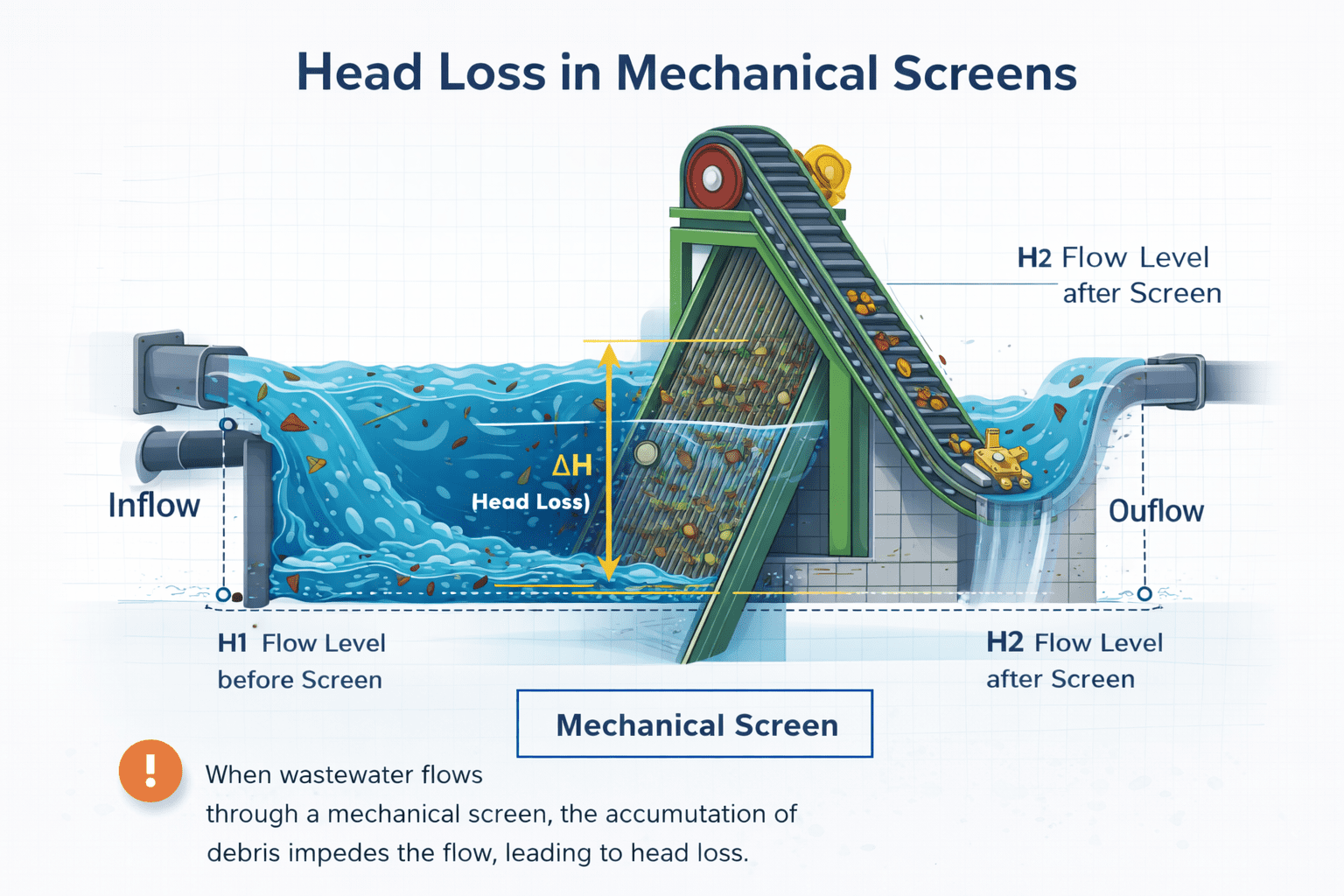
Head loss means the dropping of the pressure (or energy) of water when it passes through mechanical screens. It is caused by resistance from the screen bar, waste accumulation on the screens and turbulence induced in the flowing water.
In other words, when water passing through a screen, it is being blocked, so that the water slows down and has lost its energy. The drop of water levels between before and after screens is regarded as head loss.
In wastewater treatment plants (WWTPs), an optimal head loss value must be obtained due to it has direct influence on hydraulic efficiency and whole working efficiency of the treatment plant.
Effects of Controlling Head Loss
- Decreased flow rate
- Increased pumping power required
- Risk of overflow
- Wear and tear on machinery
- Inefficient screening.
Effective management of head loss results in efficient functioning of screens like in Sewage Treatment Plants (STP) and Effluent Treatment Plants (ETP).
Factors Leading to head loss in Mechanical Screens
Several factors cause head loss in mechanical screens. Knowing these helps to design and operate efficient screens.
Screen Bar Spacing
The screen bars cause one of the primary head losses. They have their individual bar width, their numbers per unit length, and thus spacing of these bars has an effect on head loss.
- Fine screens (1-6 mm spacing) Higher head loss
- Coarse screens (10-50 mm spacing) Lower head loss
Correct choice of bar spacing is important for both screening efficiency and hydraulic efficiency.
Debris Accumulation
Once solids are on the surface, they build up, reducing available opening area and increasing resistance. This can be attributed to various materials like
- Organic waste
- Plastics & rags
- Sand and grit
Regular cleaning of the screen prevents build-up and in turn, head loss is reduced.
Flow Rate
High flow rates cause higher velocity, which in turn means greater resistance and hence a greater head loss. Flow velocity depends upon time and is higher during periods of high usage or if there are stormwater flows or industrial discharges, e.g. During peak flow. Screens are designed to tolerate peak flow rates.
Screen Angle and Design
Angle of inclination at which the screen is placed relative to flow can significantly reduce the head loss encountered when compared to a vertical screen, which tends to create greater resistance to flow.
- Vertical screens: Higher resistance
- Inclined screens: Reduced head loss
Poor Maintenance Procedures
Lack of maintenance and poor cleaning schedule of screens causes blockage of the screens. Regular maintenance includes:
- Manual cleaning delays
- Mechanical failures.
Calculation of Head Loss in Mechanical Screens
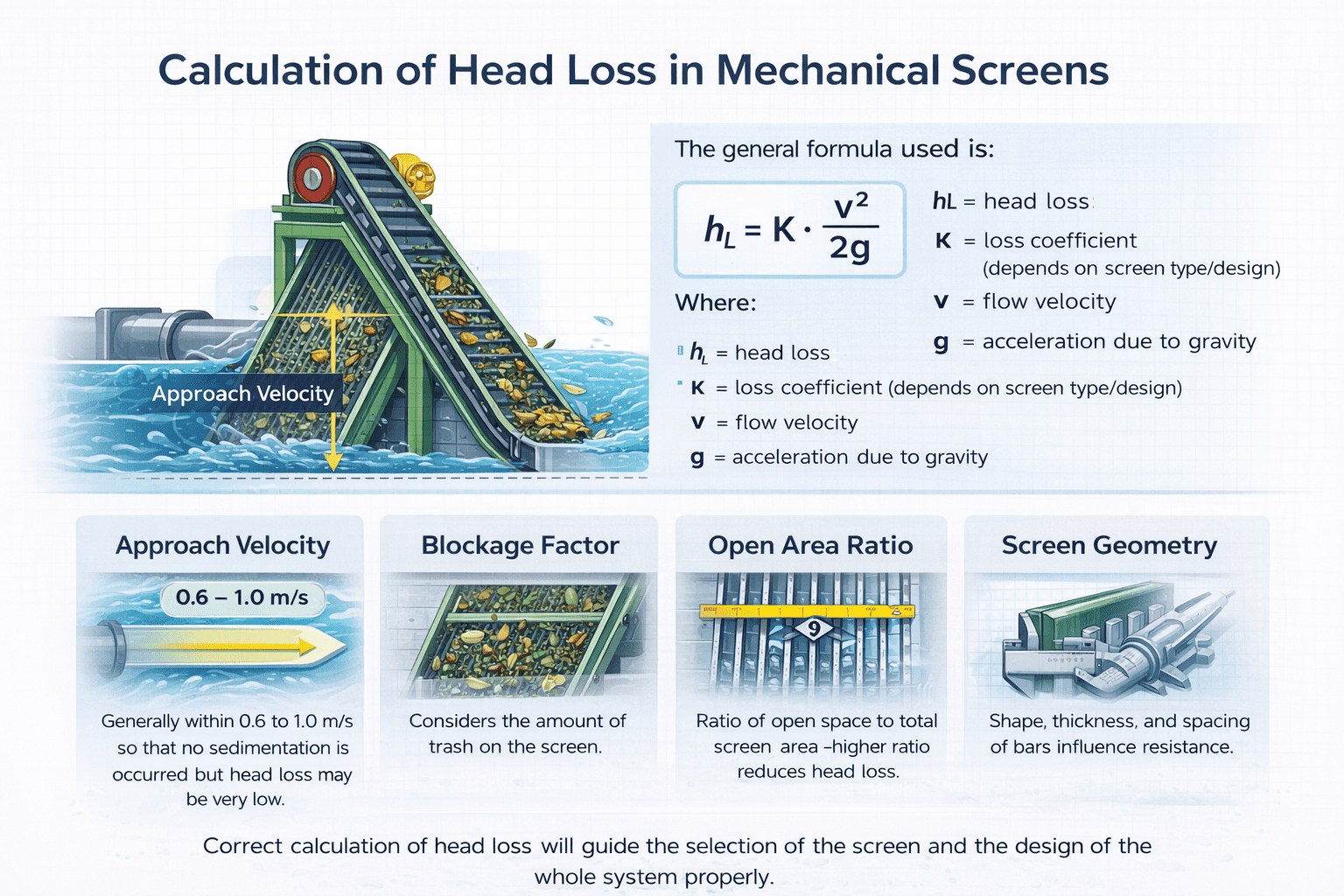
The general formula used is:
hL = K · (v2 / 2g)
Where:
- hLh_LhL = head loss
- KKK = loss coefficient (depends on screen type/design)
- vvv = flow velocity
- ggg = acceleration due to gravity
Approach velocity
Generally within 0.6 to 1.0 m/s so that no sedimentation is occurred but head loss may be very low.
Blockage factor
Considers the amount of trash on the screen.
Open Area Ratio
Ratio of open space to total screen area—higher ratio reduces head loss.
Screen Geometry
Shape, thickness, and spacing of bars influence resistance.
Correct calculation ofhead loss will guide the selection of the screen and the design of the whole system properly.
Effects of the head loss on the Plant Operation.
1. Increased the energy consumption
Excessive head loss increases the power consumed by pumps for maintaining the required flow.
- Increased electricity cost
- Reduced life expectancy of the pumps
- Increased running and maintenance cost.
Energy-efficient plants try to reduce head loss.
2.Reduced hydraulic efficiency
High head loss upset the balance of flow in the whole plant.
- Non uniform flow and distribution
- Reduced throughput
- Inefficient operation.
3.Overflows or floods
High head loss increases the water level upstream of screen resulting in overflow:
- Water level increase to high value so that it may overflow through sides or top
- Flood may occurred in the screening chambers.
4. Screening efficiency decreased
Increased flow separation around bars, increased disturbance and unpredictable water flow in screening chamber can cause the bypassing of some solids. Reduced capture rate of screen. The screening efficiency decreased and the downstream equipment is likely to become clogged
Tips for Reducing Head Loss in Mechanical Screens:
There are two primary strategies for managing and reducing head loss in mechanical screens: modifications in design, and adjustments in operational practices.
Modify Screen Design
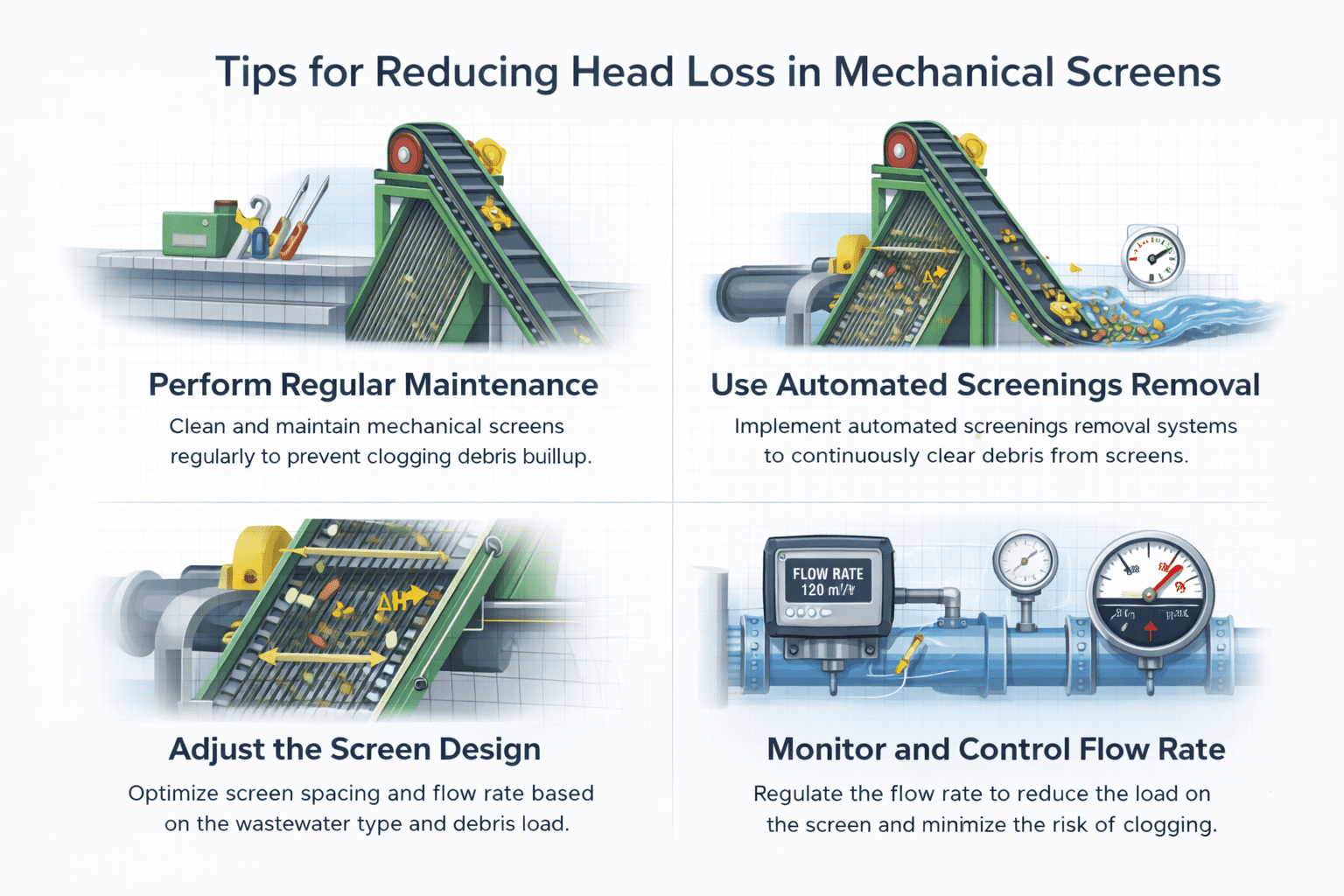
- Use appropriate bar spacing
- Increase open area ratio
- Employ inclined screen design
The contemporary mechanical screen is manufactured as a balance between an efficient and a hydraulically performant unit.
Incorporate an Automatic Cleaning system
An automatic rake or cleaning device helps to reduce blockage and head loss by continuously removing solid material that might accumulate on the screen.
- Continuous Cleaning
- Reduce operator involvement
- Enhance system performance
Ensure Adequate Flow Velocity
Maintain a flow velocity that prevents sedimentation and minimizes excessive turbulence.
- Maintain reasonable velocity
- Design the screens to meet the demands of the highest expected flow rate.
Perform Routine Maintenance and Inspections
Regular check-ups ensure that screens are not becoming clogged or damaged.
- Check for damage
- Clear accumulation of debris
- Perform any needed repairs
Utilize Advanced Screening Technology Solutions
The industry is currently benefiting from advanced mechanical screening systems such as the ones provided by Adroit Water Technologies that will assist in
- Reducing the head loss,
- Increasing the efficiency of screens
- Improving system performance.
Adroit Water Technologies’ screening devices are engineered to efficiently clean screens with minimum effort, which will ultimately be beneficial in both industrial and municipal sectors. The design aims to obtain improved performance at a reduced level of head loss.
The Importance of Mechanical Screens in Current Water Treatment Facilities:
Mechanical screens represent the first line of defense against solids that could disrupt the subsequent water and waste water treatment processes. These processes include, but are not limited to: biological treatment, sedimentation, and filtration. The successful execution of the process depends greatly on the operation of the mechanical screening system with the appropriate controlled level of head loss to result in:
- Optimum performance in treatment operations
- Minimum operation cost
- Durability of all equipment
Given the growing importance of maintaining sustainable water resources in current times, efficient management of head loss is at the fore front of water treatment operations.
Screening Technology- The Future
Recent developments have been undertaken to further reduce the head loss and enhance screen performance; these developments include:
- Smart monitoring systems
- Advanced cleaning mechanisms
- Automated flow control using artificial intelligence
- Development of energy-efficient equipment
Wrapping Up!
In conclusion, head loss in mechanical screens is an important design and operating parameter. By knowing the sources, calculating head loss accurately and applying the right control mechanism, plant operators can attain optimum performance in the system.
Investing in modern screen technology along with good operation and maintenance practices can substantially decrease the head loss which results in better performance and cost effectiveness. Adroit Water Technologies offer solutions that assist industries overcome such problems in water management.
FAQs for Head Loss in Mechanical Screens:
What is the normal range of head loss for mechanical screen?
Normal head loss range falls between 100 mm to 300 mm, this depends on the type and application of the screen. An adequate head loss helps in efficient operating the screen without overloading of the pumps and also helps in preventing overflow of the treatment plant.
What is the effect of debris on the head loss in a screen?
Debris accumulation reduces the passages for water flow and hence increases resistance, thus the head loss is increased. This reduces the efficiency, energy consumption and could lead to overflow of the treatment plant if cleaning is not maintained regularly.
Why is the head loss important for a waste water treatment plant?
Head loss is a critical design parameter for a waste water treatment plant and also helps in operating it. Head loss affects the efficiency, operating costs and equipment integrity.
How is the head loss decreased in a mechanical screen?
Head loss can be decreased by optimum screen design, appropriate bar spacing, maintaining cleaning schedule, using automatic systems, choosing modern and efficient technology.
How is the head loss affected by the flow velocity in the screen?
Head loss is increased with the increase in the velocity due to higher turbulence and resistance in the flow passages.
Which mechanical screen can result in minimum head loss?
Inclined and step screens usually have minimal head loss compared to the vertical screens because of better flow pattern.\